

You've built a successful B2B software product, and now your customers are asking the same question: "Does your software integrate with X?" It's a familiar scenario. Your sales team is losing deals because prospects need your platform to connect with their CRM, ERP, or marketing automation tools, but you don't have the ability or capacity to meet all those requests.
Let's consider your options for building integrations – specifically, cloud integration platforms, and see how they compare to other approaches.
What is a cloud integration platform?
Think of a cloud integration platform as a bridge-building service that lives in the cloud.
Imagine you need to connect two islands (app 1 and app 2). Instead of building a bridge from scratch every time, a cloud integration platform gives you pre-built components, tools, and infrastructure to assemble the bridge. The platform handles the heavy lifting – authentication, data transformation, error handling, and monitoring – so you don't have to build this stuff from scratch every time.
These platforms typically offer pre-built connectors to popular business applications, visual workflow designers, and hosting infrastructure. You build your integrations, and they run in the cloud without requiring you to maintain servers or worry about infrastructure.
The two main categories of cloud integration platforms
When evaluating cloud integration platforms, there are two primary deployment models: embedded integration platforms and traditional integration platforms (also called enterprise integration platforms).
Embedded integration platforms (aka embedded iPaaS)
An embedded integration platform is designed specifically for B2B software companies that want to offer native integrations to their customers. The key piece here is "embedded" – since these integrations appear as an integral part of your product.
With this approach, your customers configure and manage their own integrations directly within your application interface. They might click an "Integrations" tab in your product, select the apps they want to connect, authenticate their accounts, and customize data mapping, all without leaving your product.
From your customers' perspective, these integrations look and feel like features of your software. They don't know, or care, that you've built them on a platform.
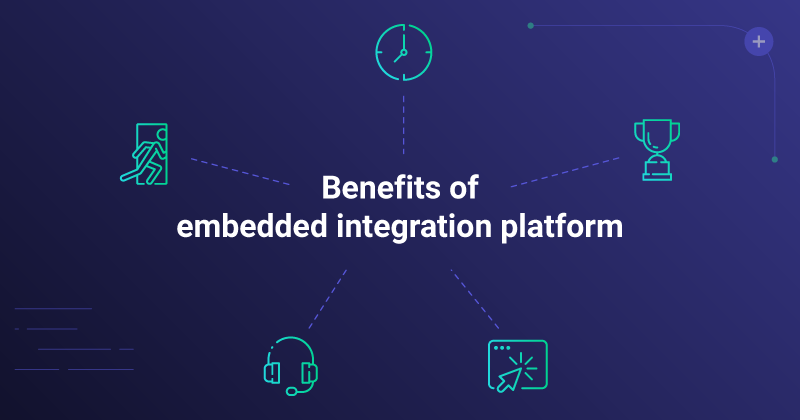
Key benefits:
- White-label experience: Integrations are branded as yours, maintaining product consistency
- Customer self-service: Your customers activate and configure their own integrations, reducing your support burden
- Scalability: You can support hundreds or thousands of customers, each with unique integration configurations
- Faster time-to-market: Build integrations once, deploy them to all customers
Traditional integration platform (aka iPaaS)
A traditional integration platform is designed to connect systems within a single organization. These are the tools IT departments use to integrate their systems.
Think of platforms like Zapier for business users or enterprise tools like MuleSoft and Boomi. These solutions help companies connect their internal systems by tasks such as linking Salesforce to their accounting software or syncing customer data between marketing and support tools.
Traditional iPaaS solutions aren't optimized for B2B software vendors who need to deploy integrations to multiple customers. They're designed for one-to-one scenarios, not one-to-many.
How about other approaches for integrations?
Beyond the aforementioned cloud integration platforms, you have other options for building integrations. Let's see what they are.
Build custom middleware in-house
Creating custom middleware means building your own integration infrastructure from the ground up. Your development team writes code to connect your application with each third-party tool, manages authentication, handles data transformation, and maintains the entire system.
Costs
Building custom infrastructure requires significant upfront investment. You'll need experienced developers (who don't come cheap) to build and maintain the infrastructure. Beyond initial development, you'll face ongoing costs for hosting, monitoring, security updates, and adding new integrations. Each new integration multiplies these costs.
Then, you have opportunity costs. Every hour your devs spend building integration infrastructure is time they're not spending on your core product features.
Time-to-market
Custom development is slow. Building a single integration from scratch can take weeks or months, depending on the third-party API and customer requirements. Multiply that by the dozens of integrations your customers might need, and you're looking at years of dev work.
Scalability
Custom infrastructure can become a maintenance nightmare as you scale. Each integration requires ongoing updates when third-party APIs change. Monitoring and debugging across multiple custom integrations requires specialized knowledge. As your customer base grows, performance issues and edge cases multiply, requiring constant attention from engineering.
Use an enterprise service bus
An enterprise service bus (ESB) is an integration technology from the pre-cloud era. An ESB is typically an on-premise system that routes messages between different applications within a company's data center.
Costs
ESBs come with substantial upfront licensing costs and require dedicated infrastructure to run. You'll need specialized expertise to configure and maintain them. For a B2B software company, ESBs are typically overkill because they're designed for large enterprises with complex internal IT environments, and not for delivering customer-facing integrations.
Time-to-market
ESBs, originally designed decades ago, were not intended for multi-tenant, cloud-native environments. Scaling an ESB to support hundreds or thousands of customers, each with unique integration needs, is not feasible. While these systems excel at complex internal integrations, they are the wrong tool for B2B SaaS integrations.
Scalability
ESBs, originally designed decades ago, were not intended for multi-tenant, cloud-native environments.
What's the right choice for your company?
So which approach makes sense for your B2B software company? Let's break things down.
Choose custom development if:
- You have essentially unlimited development resources and time (and want to spend it on integrations)
- You're building highly specialized integrations that no third-party platform supports
- You have specific security or compliance requirements that third-party platforms won't meet
Choose an embedded integration platform if:
- You're a B2B software company that needs to offer integrations to a lot of customers
- You want integrations to feel like product features
- You need customers to self-service their own integration configurations
- You're supporting (or plan to support) multiple customers with the same integrations
- Time-to-market is critical for your competitive position
Choose a traditional iPaaS if:
- You're connecting internal systems within your own organization
- You're a business user who needs to automate workflows between your own tools
- You don't need to deploy integrations to external customers
Avoid ESBs unless:
- You're a large enterprise with complex on-premise systems that need to be connected
- You have specific regulatory requirements preventing use of a cloud integration platform
- You have extensive existing ESB infrastructure and expertise
As you evaluate your integration strategy
Integration capabilities are expected. Your competitors are offering integrations. Prospects expect them. Delays cost you deals and market share.
Build-versus-buy has shifted. Specialized platforms have matured to the point where building custom integration infrastructure rarely makes financial sense for B2B software companies. That said, some of the value provided by AI-assisted development may push the needle back toward "build" for some.
Not all cloud integration platforms are created equal. Embedded integration platforms serve fundamentally different needs than traditional integration platforms or ESBs. Choose the tool that provides the capabilities you need.
Consider the total cost of ownership. Don't just compare platform subscription costs – factor in development time, maintenance overhead, opportunity costs, and scalability limitations.
Time-to-market matters more than you think. Every month without key integrations is revenue you're leaving on the table. The ability to rapidly deliver new integrations translates directly into market share.
Common questions
Question: What is the difference between iPaaS and a cloud integration platform?
Answer: A cloud integration platform is the broader category – any hosted, cloud-based solution that connects applications by providing pre-built connectors, visual workflow designers, and managed infrastructure for authentication, data transformation, error handling, and monitoring.
iPaaS is one deployment model within that category, and it comes in two distinct flavors:
- Traditional iPaaS connects systems within a single organization. IT departments use these tools to link internal applications – for example, syncing a CRM with an accounting system. They're built for one-to-one scenarios and aren't optimized for deploying integrations to external customers at scale.
- Embedded iPaaS is built specifically for B2B software companies that need to offer integrations as a product feature. With a platform like Prismatic, integrations appear natively inside your product UI, carry your brand, and can be configured by each customer independently – without your engineering team involved in every deployment.
Question: When should a B2B SaaS product use an embedded integration platform?
Answer: For most B2B SaaS companies, the right time is earlier than you think. An embedded integration platform makes sense when:
- Customers are asking for integrations. If your sales team is losing deals because prospects need your product to connect with their CRM or ERP, the demand signal is already there.
- Integrations must feel like product features. An embedded iPaaS delivers a white-label experience: customers interact with integrations directly within your application.
- You're supporting multiple customers with the same integrations. Build once, deploy to all customers with their own unique configuration – no one-off copies to maintain.
- Customers need to self-serve. Rather than having engineering configure every integration instance, customers can authenticate, map data, and activate integrations themselves.
- Time-to-market is a competitive factor. Every month without key integrations is potential revenue left on the table.
Custom in-house development may still be the right answer for highly specialized or compliance-constrained scenarios. But for the majority of B2B SaaS companies, an embedded iPaaS offers the fastest, most cost-effective path to delivering the integrations customers need.
Question: What challenges do integration platforms solve?
Answer: Building integrations is harder than it looks – and scaling them is harder still. Integration platforms address several compounding challenges:
- Inconsistent API standards. There is no universal standard for how third-party APIs authenticate or format data. Some use OAuth 2.0; others rely on API keys. Data may arrive as JSON, XML, or CSV. An integration platform abstracts this complexity so your team isn't rebuilding common logic from scratch every time.
- Engineering bottlenecks. When integrations compete for bandwidth with core product development, something loses. Low-code tooling and pre-built components let non-devs handle common integration scenarios, freeing devs for higher-value work.
- Scaling from one integration to many. Without a platform, teams often maintain near-identical copies of each integration per customer – a growing maintenance burden. A platform provides one configurable integration that scales across your entire customer base.
- Infrastructure overhead. Hosting, monitoring, logging, alerting, versioning, and security all must be built and maintained. Platforms like Prismatic handle this layer for you, so your team can focus on integration business logic.
- Support complexity. Detailed logging and customer-facing debugging tools mean support teams can resolve most integration issues without pulling in engineering.
Moving forward
Understanding the available cloud integration platforms helps you to make the right decision about your integration strategy. Whether you choose an embedded platform, build custom integrations, or pursue another approach, the key is to tie your integration strategy to your business goals.
For most B2B software companies, embedded integration platforms offer the fastest, most cost-effective way to deliver the integrations customers need without diverting the engineering team from the core product. These platforms provide the scalability, time-to-market, and customer UX you need to stay competitive.
The question isn't whether you need to offer integrations, but how you'll deliver them in a way that works for everyone involved.
Check out our 3-minute demo video to see an embedded iPaaS at work.