
Build Software Integrations the Way Your Team Works

Write integrations in code

Build integrations in low-code

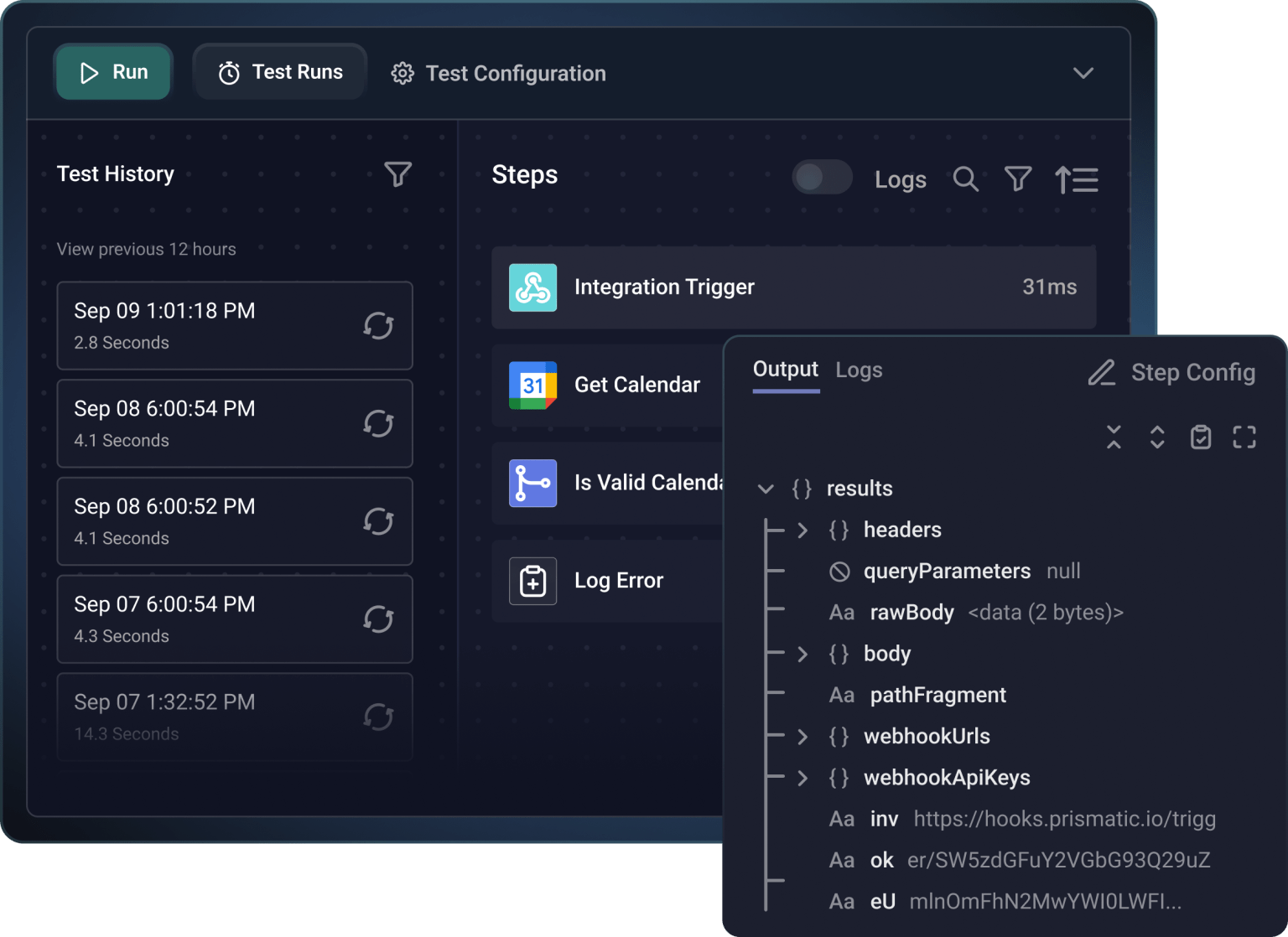
Test, demo, iterate
Automate your integration publishing process








Common questions
Embedding integrations means your customers access and manage integrations directly within your product UI. You use Prismatic's embedded SDK to add a white-labeled integration marketplace to your software with just a few lines of code. This marketplace displays your available integrations with your branding, colors, and design language, making it feel like a native feature.
Your customers can browse integrations, authenticate their third-party accounts, configure settings through intuitive wizards, and monitor integration performance – all without involving your support team. You can embed the marketplace as an iframe for quick implementation or build a completely custom UX using Prismatic's API for ultimate design control.
Absolutely. Prismatic is designed to work with your team's existing development workflow. For code-first development, your developers write TypeScript in their preferred IDE (VS Code, Cursor, etc.) with full IntelliSense support, version control, and deployment via your existing CI/CD pipelines. You can use Prismatic's CLI tool to build, test, and deploy integrations directly from the command line.
The platform includes a VS Code extension that lets devs test executions and view logs without leaving their IDE. AI coding assistants like Claude and Cursor can leverage Prismatic's MCP dev server to understand your integration context and generate code faster. Your team can also reference npm packages, call external code, and use familiar tools like Jest for unit testing. Everything integrates with your current setup – linters, copilots, version control, and DevOps processes.
No coding skills required. Prismatic includes an intuitive low-code visual designer with a drag-and-drop interface that empowers non-technical team members to build and modify integrations independently. With over 190 pre-built components covering common integration patterns, your customer success or support teams can assemble integrations by visually connecting components. They can configure authentication, map data fields, set up triggers, and define workflows without writing a single line of code.
This accessibility dramatically reduces the burden on your engineering team since technical support staff can configure new instances of integrations, while engineers only get involved when building something new or complex. Teams report that non-devs can build and deploy integrations in days using the low-code designer, compared to weeks or months required for traditional coded approaches. The platform empowers your entire team, not just devs.
Prismatic provides a purpose-built, secure infrastructure that handles all deployments and scaling automatically, so you never have to worry about servers, databases, or performance issues. Your integrations run in an enterprise-grade environment with built-in authentication management (from basic API keys to complex OAuth 2.0 flows), automatic retry logic, and intelligent queuing. The platform automatically scales to handle your load, whether you have 10 customers or 10,000.
Prismatic is SOC 2 Type II certified and compliant with HIPAA, GDPR, and CJIS regulations. You can deploy integrations globally across multiple regions with multi-tenant isolation for security. Build an integration once and deploy it to hundreds of customers with customer-specific configs and credentials. Prismatic manages token refreshes, credential storage, and security patches, freeing your team from the maintenance of integration infrastructure.
You can build any integration your customers need, from simple to highly complex. Prismatic supports integrations between modern SaaS applications (Salesforce, HubSpot, Shopify, and Slack) and legacy systems with or without modern APIs, regardless of protocol or data format. Common use cases include syncing data between CRMs and ERPs, importing customer-specific data from third-party forms, automating workflows with custom triggers and schedules, processing documents with AI, handling complex authentication flows, and managing data transformations.
The platform is particularly powerful for vertical-specific and industry-specific integrations that other platforms can't handle. Whether you're connecting to standard business applications or niche vertical market systems, building real-time data syncs or scheduled batch processes, or creating AI-powered workflows that enrich and analyze data, Prismatic gives you the flexibility to build exactly what your customers need.