
- Extensibility is three things working together: productized integrations, customer-built workflows, and agentic interactions. Integrations alone are no longer enough.
- Prismatic ran 4.2 billion executions this year, up 53% from last year. Customers also built 33,000 workflows inside products using the platform, a number that's doubling every quarter.
- FMX cut integration build time by 60% and support tickets by 50% after migrating to a code-first approach. The company now runs 21 code-first integrations carrying 307 of 394 customers.
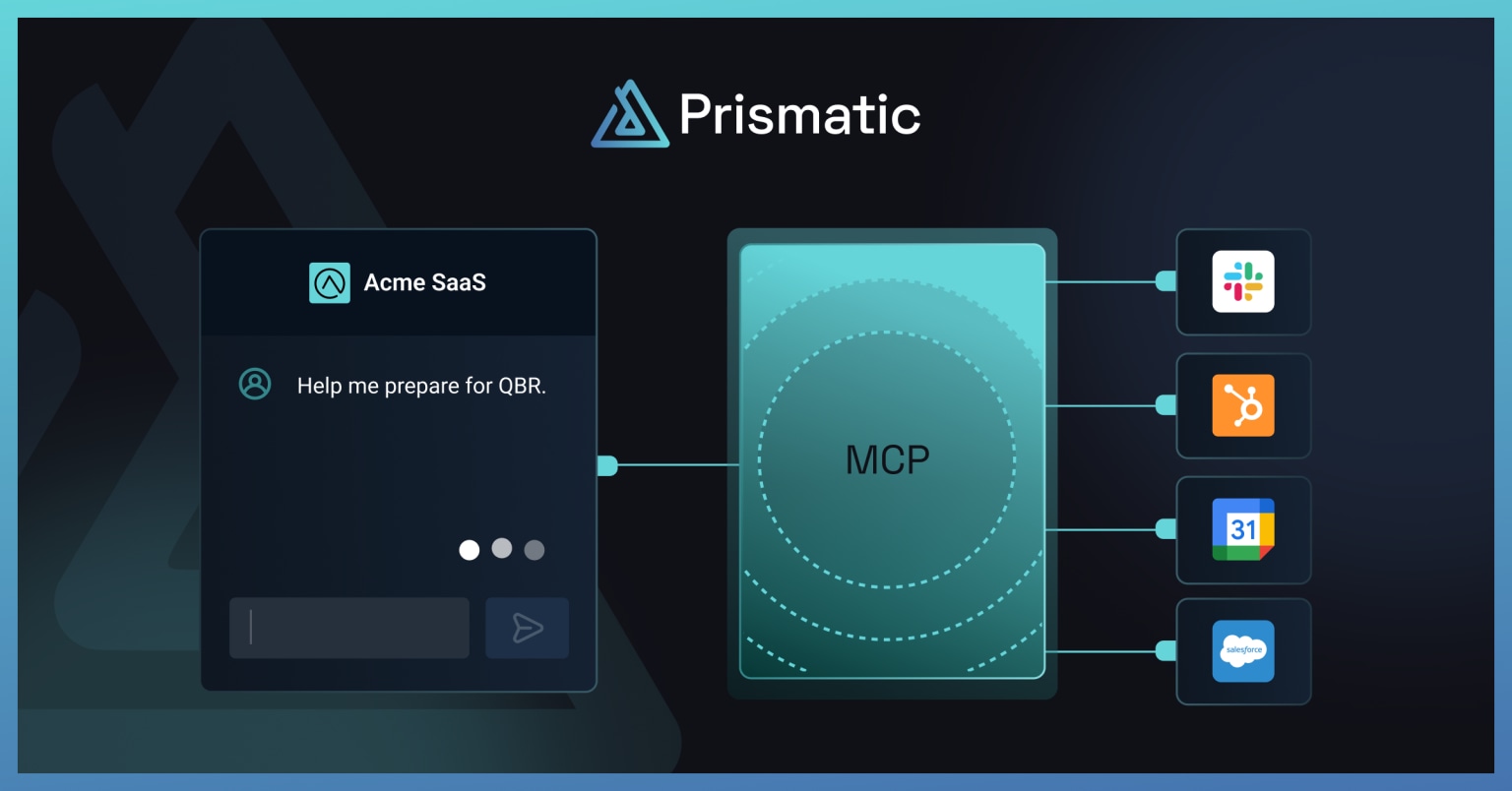
- CENTRL made its AI platform agent-ready without rebuilding its integration infrastructure. Exposing Prismatic flows via the MCP flow server gave its agents live access to Salesforce, Google Drive, and Gmail.
On September 16, we hosted Prismatic Connect, our first virtual user conference: four hours, six sessions, and two customer speakers. One thread from Michael Zuercher's keynote carried through everything: your customers' expectations have changed, and integrations alone are no longer enough.
We built the agenda around your requests: letting your customers build their own workflows inside your product, making your product agent-ready without giving up control, building integrations faster with code-native and AI, what shipped this year, what's coming next, and what it looks like when one of our customers goes all in.
If you missed a session or want to share one with your team, all recordings are below, along with summaries and doc links.
Welcome and keynote
Michael Zuercher, CEO at Prismatic

Michael opened by looking at the year and where the platform is headed. Customers are using Prismatic in ways we didn't envision seven years ago, and that is shaping the roadmap.
- The numbers. 4.2 billion executions a year on Prismatic, up 53% from last year. 33,000 workflows built by your customers inside your products, doubling every quarter.
- Three changes in how you build. You're building faster than ever with code-native integrations plus AI coding agents. You're letting your customers build their own workflows with an embedded workflow builder. And you're enabling agentic interactions with the MCP flow server.
- The insight. Integrations alone are no longer enough. Extensibility is how your product adapts to each customer's systems, workflows, and AI-driven processes. Michael's question for the day: Based on what you hear, what opportunities are there to bring more value to your customers?
Launch AI-built workflows inside your product
Jake Hagle, Director of Customer Engineering at Prismatic

Your team can't build every customer request. Each one competes with product work, and pointing customers to your API or Zapier hands the UX to someone else. Jake walked through how an embedded workflow builder (EWB) solves this, then demoed it live as a fictional SaaS company (Acme.io) with a fictional customer (Red Bull).
- What's EWB? A simplified, customizable version of the Prismatic low-code builder that you embed and white-label inside your product. Your customers see your brand, your triggers, and the connectors you choose to expose. Prismatic is invisible.
- AI Copilot does the work. In the demo, a user typed "when a new lead comes in, notify the team in Slack." AI Copilot added and configured the step, mapped payload fields, turned on listening mode, ran a test, and confirmed the message landed in Slack. Adding a Salesforce step was one more sentence.
- Your team remains in control. You select the templates and workflow contexts your customers start from, choose which connectors and actions to expose, and support those workflows on Prismatic. A customer engagement platform used this to turn automation into a paid feature that replaced Zapier, and a cyber threat intelligence platform let customers build their own incident response playbooks instead of waiting on custom development.
Learn more
Embedded workflow builder docs, AI Copilot, workflow contexts, workflow templates, and the AI Copilot Labs workshop. Ask Prismatic to enable EWB for you.
Getting agent-ready
Brian Munz, Developer Advocate at Prismatic, with Pinaki Ghosh, Software Architect at CENTRL

Agents are moving from chatting to doing. Every product team is being asked about its agent strategy, and the opportunity is to let agents safely act on their customers' data. Brian covered how the MCP flow server makes that possible, then talked with Pinaki about how CENTRL put it to work.
- Your flows become agent tools. MCP is a shared standard that lets agents discover and call tools. Take a flow you already have, add an invocation schema (a plain description of what the tool does and what it needs), and toggle it on for the MCP flow server. Works for low-code and code-first flows and with whatever agent your customers already use.
- The agent decides; the flow does it safely. The agent interprets intent and picks a capability. The flow handles the deterministic part: authentication, sequencing, and guardrails.
- CENTRL put it in production. CENTRL, an AI platform for financial institutions that assess investment managers, built CentrlX, an agentic platform whose agents needed live access to Salesforce, Google Drive, and Gmail. Rather than build that in-house, they built with Prismatic: auth and the connection UI came out of the box, customer data is accessed live and never stored (per compliance), onboarding finished ahead of a one-month budget, and a new third-party system now takes about a week.
If you already have flows in Prismatic, you're most of the way there. Pick the flows that represent valuable customer actions and expose them to the MCP flow server.
Learn more
MCP flow server docs, build your first agentic flow, flow invocation schemas, connect your agent, and the MCP flow server workshop for a deeper dive.
What's new this year?
Taylor Reece, Developer Experience Engineer at Prismatic

Taylor grouped the year's releases into four buckets, then spent most of the session live-coding through the fourth one: handling data at scale.
- Four buckets of releases. Embedded workflow builder (AI Copilot, workflow contexts, simplified connections, structured step inputs, dynamic step outputs). Dev tools (AI coding skills, every connector open-sourced, a VS Code extension, a faster toolchain, dozens of new connectors). Management (multi-tenant switching, new public regions, event webhooks, execution visibility, per-customer concurrency, instance profiles). Large data (flow concurrency, FIFO queues, batch triggers), which Taylor called the theme of 2026.
- Flow concurrency and FIFO. When a third-party system sends 10,000 webhooks in a few seconds, parallel execution can overwhelm your downstream system and eat up concurrency for every other customer. Set a flow to throttled (say, three at a time) and the rest queue up. When order matters, set it to sequential and requests process one at a time in the order received.
- Batching. A customer connects Salesforce and has a million records to import. Batch triggers fetch iteratively, queue the data, split it into batches, and fan out at a size you're comfortable with. In the demo, 1,234 records became 25 batches of 50, each its own mini execution you can inspect and rerun.
Learn more
Flow concurrency and FIFO, large data sync, Prismatic Skills, open-source connectors on GitHub, and the changelog.
Inside the roadmap
Tanner Burson, CTO at Prismatic

Tanner framed the roadmap around three trends: AI is pushing more teams toward code-first, agentic products need more connections and data than ever, and customers want more customization in the products they use. He walked through what's in flight as now, next, and later. No dates, and the further out an item is, the less specific it gets.
- Now (actively in development). Visibility leads, because as code-first becomes the default, more people on your team need to debug integrations they didn't write, so execution management and debugging get a revamped UX. A headless config experience through the embedded SDK lets you build the config wizard in your own UI. And Prismatic's Skills move to the agent skills spec, so they work in Cursor, Gemini, GitHub Copilot, and Codex, not just Claude.
- Next (soonish). Native field mapping in the config wizard, since it's the most common thing teams build there today. EWB limits you can align with your own plan tiers. And a second round of visibility work, including an alert management overhaul with a global error alert.
- Later (down the road). The problems of running at scale: a clean path for promoting work from dev to production, MCP flow server updates like EWB workflows as tools and dynamic authentication, an enhanced management add-on with audit logs and custom roles, and agent-driven management so you can investigate and fix issues from your own agents.
If something in the later bucket matters to your business, reach out to your account manager or to Tanner directly. He has specifically requested those conversations.
Learn more
Config wizard docs, embedded SDK, executions and monitoring, alerting, and Prismatic and AI.
From natively-built to Prismatic
Libby Stengel, VP of Customer Success at Prismatic, with Jeff Holmes, Engineering Manager at FMX

Most new Prismatic customers address their immediate integration needs right away. The harder question is what to do with the natively-built (in-house) integrations they have that already work. FMX, a facilities and maintenance management platform, moved all of its integrations to Prismatic using a code-first approach.
- The move. FMX's integrations were C# scheduled jobs, eating roughly 20% of engineering time with no dedicated team and a steady source of customer frustration. The team had three months to get off a previous iPaaS, so low-code was the stopgap. As code-first matured and AI skills sped up development, migrating became cheaper than maintaining. Today, 21 code-first integrations carry 307 of FMX's 394 customers on the Prismatic platform.
- The results. Time to build is down 60%. Integration support tickets are down 50%. FMX's customer success team monitors integration performance firsthand, and in Jeff's words, adding an integration is a business decision, not an architecture problem.
- Best practices for your move. Build a proof of concept with code-first and AI skills. Staff it as an engineering effort and chip away every sprint instead of doing one big push. Build common libraries, agent context knowledge, and an MCP server for your own application.
Learn more
Code-native integrations, converting low-code to code-native, Prismatic Skills for AI-assisted development, and the building faster with AI workshop.
What's next
Thank you to everyone who attended, and to CENTRL and FMX for sharing what they've built. Here are a few ways to keep going:
- Watch the recordings. Every session is embedded above. Share them with your team.
- Join the fireside chat. On October 1 at 2 PM ET, Michael and Tanner will have a follow-up to Connect with a webinar on "One-Size-Fits-All Software Is Dead. Your Customers Killed It." RSVP now.
- Get the newsletter. Everything from monthly product updates and the thinking behind them to the latest workshops and webinars. Sign up now.
- Try something new. Embedded workflow builder, the MCP flow server, and code-first with AI skills are all part of the same platform you already use. Reach out to your account manager or in your shared Slack or Teams channel, and we'll help you extend your product functionality even more.