

B2B SaaS integrations are no longer optional; they're essential for survival in today’s competitive marketplace. The modern tech stack is integrated, with the G2 2024 Buyer Behavior Report showing that integrations are a top consideration for B2B software buyers. As businesses increasingly rely on specialized SaaS solutions, the expectation for seamless connectivity between applications has become non-negotiable. The ability to connect effortlessly with their customers’ other apps makes SaaS products more appealing to both potential and current customers.
And integrations will only increase in importance and complexity. The average organization now uses hundreds of SaaS apps, creating an ever expanding list of integration requirements that influence your sales and drive your customers’ long-term satisfaction. Despite this critical importance, many B2B SaaS companies struggle with their current integration strategies – whether building in-house, wrestling with enterprise iPaaS limitations, working around unified API constraints, outsourcing to third-party devs, or managing some complex blend of these approaches.
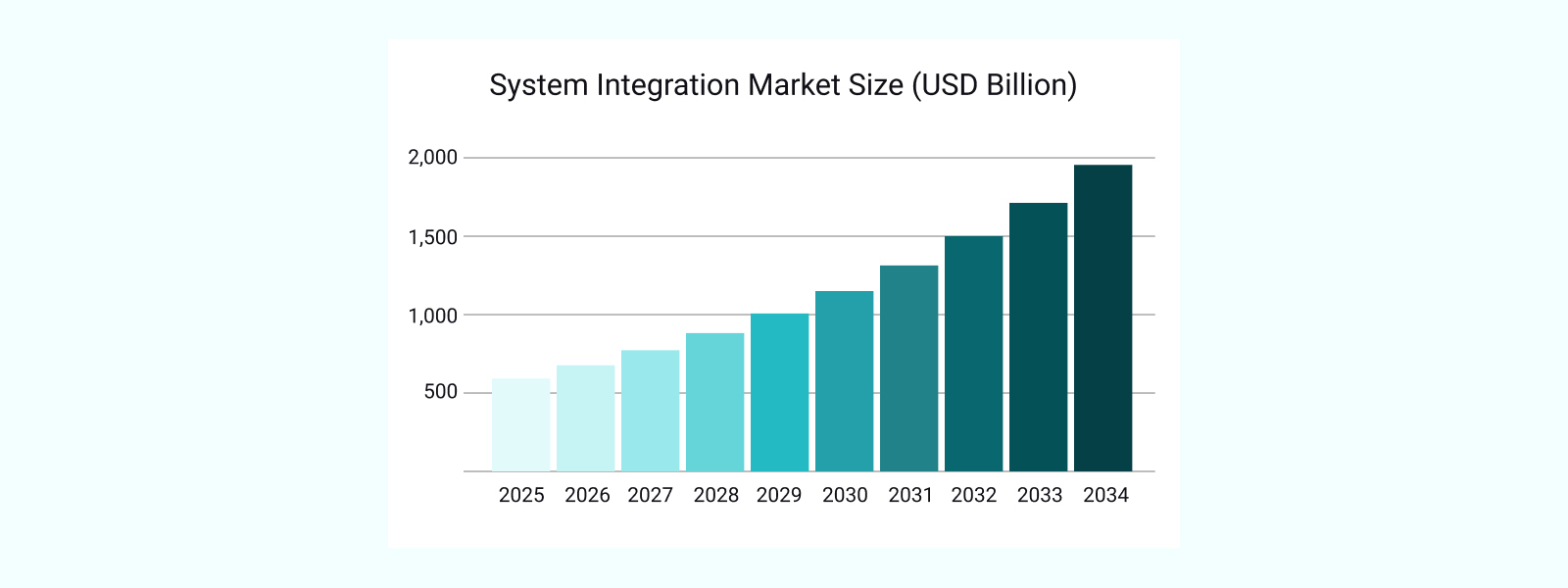
Zoting, S. (2025, May 21). System Integration market size to surpass USD 1,946.37 BN by 2034. https://www.precedenceresearch.com/systemintegration-market
However, there’s a proven way to address these challenges without derailing your product roadmap, overwhelming your engineering teams, or compromising your customers’ experience. Forward-thinking executives are solving integration challenges with embedded iPaaS – a purpose-built platform designed specifically for B2B SaaS integrations.
This guide examines the critical areas where integration challenges most significantly impact your business outcomes. We'll explore how these issues affect your bottom line and demonstrate how an embedded iPaaS approach delivers superior results compared to traditional in-house development.
Strategy
ROI
We probably save 95% of [engineering] time. We’ve deployed far more integrations than we would have without Prismatic.
Challenge
In-house integrations almost always consume more resources than initially expected, resulting in poor ROI. Upfront custom development inflates COGS , but that’s only the beginning as maintenance, infrastructure, security compliance, and regular API changes keep adding to bill. Instead of driving product innovation, engineering spends its time babysitting integrations. TCO quickly exceeds projections, sometimes by several multiples. One-off integrations inflate budgets, payback periods stretch, and engineering is prevented from coding features to win new customers. What was meant to help gain new business becomes a cost sink that executives struggle to justify to stakeholders.
Solution
With Prismatic, you reverse that ROI problem. The platform reduces integration development time by up to 95% and substantially cuts ongoing expenses. You team builds once and deploys to many, thanks to flexible configuration options. Integrations scale with your company instead of killing budgets with custom development. Your devs focus on product innovation to drive ARR and MRR while Prismatic handles integration infrastructure, maintenance, and security. Customer-facing teams deploy and manage integrations directly, delivering faster outcomes. Integrations shift from a cost burden to a revenue driver – producing clear, defensible ROI in savings and growth.
Competition
Challenge
Companies that build integrations in-house fall behind competitors who can deliver more integrations, faster. Lengthy internal dev cycles mean that by the time one integration is complete, more efficient competitors may have released several. Prospects increasingly view integration capabilities as a deciding factor in vendor selection, and falling short can negatively affect sales. An in-house approach forces engineering into constantly fielding customer requests. As a result, competitors can position themselves as more connected and better aligned with customer needs. The integration gap becomes a significant competitive disadvantage, weakening your ability to sell to your TAM.
Solution
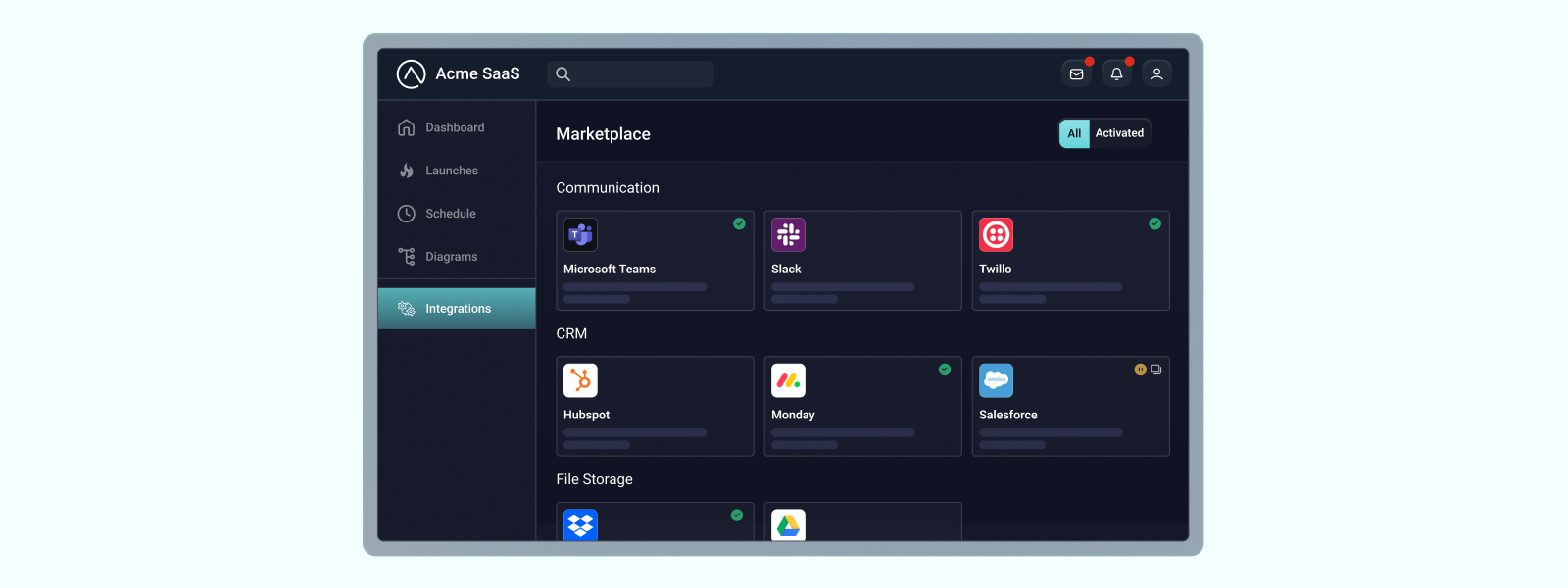
With Prismatic, you can close that gap. The platform provides pre-built connectors to quickly create integrations with customers’ standard apps in days instead of months. Then, deploy an integration marketplace to give prospects visibility into a growing integration ecosystem, giving you a competitive advantage in every sales conversation. Your team can confidently say "yes" to integration requests, backed by code-native and low-code tools, scalable infrastructure, and more. Instead of chasing competitors, you set the pace – positioning your SaaS product as the more connected, flexible solution to win deals and drive growth.
Churn
Challenge
When in-house integrations break or fail to address customer needs, churn increases. Outages, missing features, and slow delivery undercut NRR and GRR, making it easier for customers to find competitors with greater integration reliability. Extensive custom code and limited support tools often mean issues go undetected until customers complain – and by then, the relationship damage has already been done. Without a scalable, future-proof approach, in-house integrations don’t match customer expectations. Customers increasingly expect off-the-shelf integrations to the tools they use daily, and when a SaaS product can’t deliver, they move to one that can.
Solution
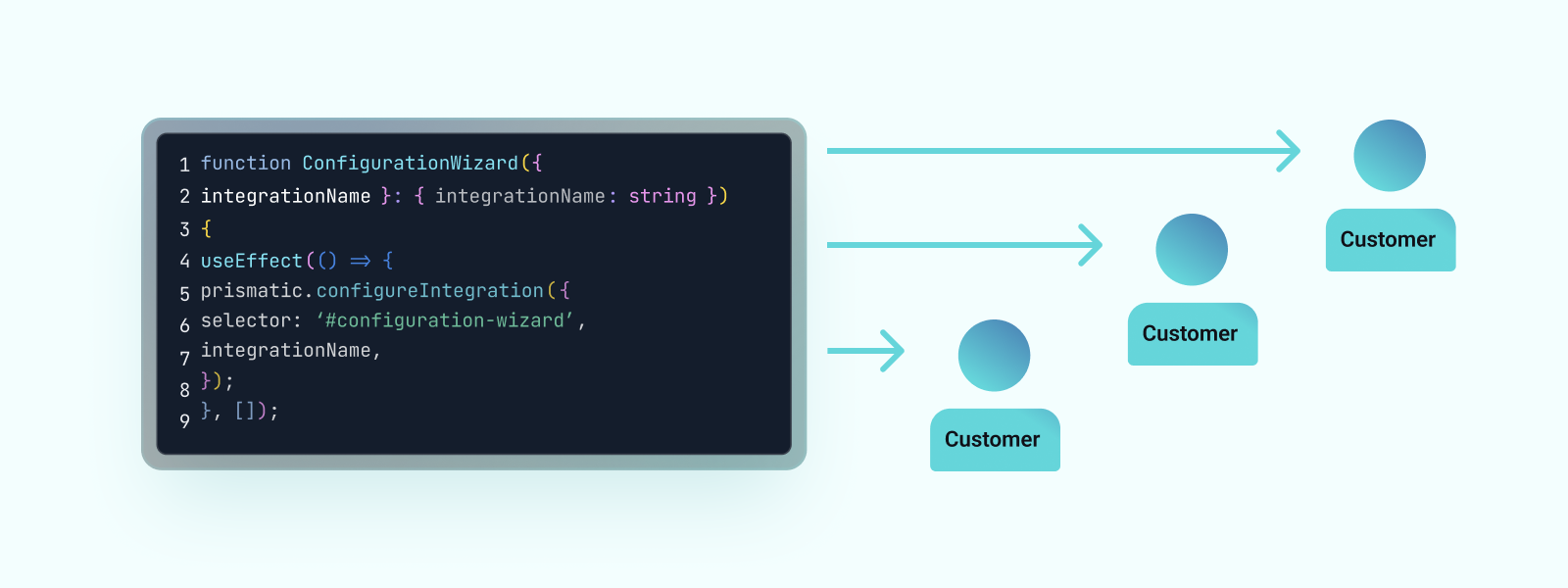
With Prismatic, integrations fuel retention. The platform supports dependable, scalable integrations that evolve with customer needs, backed by monitoring and alerting that lets support catch issues before customers do. Your customers gain confidence through reliable, self-service integrations they activate themselves, powered by guided setup wizards. Instead of obvious add-ons, integrations become essential product features that increase your product’s value. Retention strengthens, ARPC grows, and what previously contributed to churn becomes a growth engine.
Operations

Get a pdf of this guide to share with your team. Learn proven ways to handle integrations without ballooning your budget, overwhelming product and engineering, or compromising your customers’ user experience.
Resource allocation
With Prismatic, we’re able to deliver integrations in far less time while streamlining our engineering effort. Prismatic has given us the ability to more widely build integrations across our teams. It has also allowed our customer-facing teams to handle customer-specific deployment.
Challenge
Experienced devs often get pulled into working on in-house integrations instead of advancing the core product. This poor use of talent creates resource bottlenecks and forces expensive trade-offs between strategic initiatives and customer integration requests. Integration projects can consume enormous engineering capacity and pull experts away from work that drives differentiation. Since integration work often requires senior devs with specialized skills, OPEX increases as other projects lose momentum and leaders struggle to justify a rising headcount. As integration requests pile up, companies risk slowing velocity and weakening their ability to differentiate at scale.
Solution
With Prismatic, you can free your devs to focus on what matters most – your product. You eliminate repetitive work and accelerate delivery by offloading integration infrastructure and taking advantage of pre-built connectors. Low-code tools enable non-devs to create simpler integrations, while code-native capabilities address more complex needs. This balance ensures integrations are delivered faster without tying up your senior devs. Non-devs can also deploy and manage integrations, multiplying your capacity without expanding headcount. Use Prismatic to optimize resources and allow your devs to focus on your core product.
Time to market

Challenge
Building integrations in-house can slow down an entire go-to-market strategy. Each new integration requires specialized coding, testing, and deployment cycles, which can stretch to three to six months per project. These long lead times slow product launches and customer onboarding, and delay ARR recognition. And every new customer request adds to a growing backlog, further increasing delays. As integration projects pile up, key opportunities from your ICP slip away. Over time, this consistent lag erodes competitive advantage and stalls product growth.
Solution
With Prismatic, you can accelerate time-to-market and move faster than the competition. The platform provides a library of pre-built connectors and other components with a flexible low-code designer and a powerful TypeScript SDK, enabling your team to deliver integrations in days rather than months. Instead of writing custom integrations from scratch, you can easily configure, reuse, and scale integrations across customers. This reduces your backlog and speeds up onboarding, shortening time to value and helping your revenue teams recognize income faster. Streamline the entire integration lifecycle while ensuring devs focus on core product innovation. The result is greater agility, quicker market capture, and a product that meets your customers’ needs.
Scalability
After evaluating numerous embedded iPaaS vendors, Prismatic emerged as the clear leader for scaling customer integrations. Their comprehensive toolset not only enables access to diverse data sources but empowers our customers to build, deploy, and manage their own integrations with confidence.
Challenge
Many things break when in-house integration systems are pushed to scale. As customer demand increases, each new integration requires refactoring and infrastructure adjustments. The burden of maintaining hundreds or thousands of customer-specific integrations exposes operational and infrastructure fragility. Instead of writing functionality that fuels growth, dev teams are forced into a reactive cycle of patching and firefighting. The lack of standardized methods makes scaling inefficient, frustrating internal teams and customers who rely on them. Ultimately, what works in the early stages becomes a significant bottleneck.
Solution
With Prismatic, you can achieve healthy, scalable integration growth without the pain. The platform’s multi-tenant architecture is built for embedded integrations, so you can create an integration once and deploy it across your customer base. Reusable logic and automated infrastructure management ensure variable loads are handled consistently. Instead of scaling costs in direct proportion to new customers, you keep COGS predictable, with standard build, deploy, and manage processes. Expand to serve hundreds or thousands of customers while keeping costs down and teams focused on strategic growth initiatives.
Risk
Security and compliance

Challenge
Creating in-house integration infrastructure introduces numerous security and compliance risks. Managing customer credentials, ensuring end-to-end encryption, and complying with regulations such as SOC 2, GDPR, and HIPAA demands deep expertise and constant vigilance. Integrations based on custom coding are less likely to conform to security best practices, thereby introducing vulnerabilities that can expose customer data. These gaps increase the risk of breaches, audits, fines, and additional scrutiny, potentially damaging a company’s reputation and undercutting customer trust. As compliance needs increase, maintaining controls internally becomes a resource drain.
Solution
With Prismatic, you can shift the burden of security and compliance to a purpose-built integration platform. The system manages credential storage and data encryption, and complies with leading standards such as SOC 2 Type II, GDPR, HIPAA, and CJIS. Audit-ready controls, logging, and governance features are built directly into the platform, reducing exposure. Instead of tying up devs with monitoring and certification upkeep you can rely on Prismatic for the infrastructure and compliance. Protect customer data and maintain trust without requiring additional CAPEX to create and sustain a custom security framework.
Vendor lock-in
As a software developer, I love how easy Prismatic makes it to create integrations that can be reused by many of my customers with minimal effort on their part.
Prismatic also offers me the flexibility to write all or part of an integration in TypeScript for when I just need to get do something in a very specific way or when I need to solve a problem that I know I can do very efficiently in code.
Challenge
Teams often think that building integrations in-house reduces dependencies, but that’s usually wrong. Custom code creates rigid architectures for specific systems, and the knowledge required to maintain them exists only within the engineering team. Over time, this internal technical debt can be just as restrictive, costly, and risky as reliance on an external vendor. As ecosystems evolve and customer demands increase, executives find themselves in a bind – unable to easily migrate integrations or substantially expand the customers served without costly rewrites or major overhauls. What begins as an attempt to maintain control creates deep lock-in to inflexible and unsustainable frameworks.
Solution
With Prismatic, you retain flexibility while avoiding lock-in. The platform’s open, extensible architecture supports low-code and code-native development, giving you complete control over how integrations are built and maintained. TypeScript, reusable components, and a custom component SDK ensure your integrations remain adaptable as third-party systems change. Instead of accruing tech debt or relying on hard-to-transfer institutional knowledge, maintain a standardized lifecycle that scales with your business. Free your team to meet real-world scenarios, adapt to new needs, and protect long-term flexibility.
Data governance

Challenge
Without standardized processes, data governance for in-house integrations becomes fragmented – leading to inconsistencies, errors, and critical blind spots in decision-making. Custom-built integrations are often black boxes, with non-existent logging and monitoring tools, making tracking how data moves between systems nearly impossible. This lack of visibility increases the risk of compliance gaps, weakens security postures, and forces teams to patch together oversight tools that create more complexity than clarity. As customer volumes grow, the inability to govern and audit data flows for hundreds of integrations increases operational risk and undercuts confidence in compliance efforts.
Solution
With Prismatic, you can bring order and control to data governance. The platform includes robust logging, and alerting functionality for every integration, providing unparalleled integration visibility. Standardized processes ensure consistent security and compliance controls, reducing risks in that domain. Instead of relying on fragmented oversight tools and engineering’s knowledge of custom setups, you build, deploy, and manage integrations from a single platform. Streamline governance, simplify compliance, and gain the visibility needed to scale confidently without sacrificing trust or control.
Market/Customers
Customer experience

Challenge
Poorly executed integrations can damage the customer experience. In-house integrations, with their heavy customization and lack of UI often frustrate customers during onboarding and beyond. Lengthy setup processes and limited self-service capabilities force them to depend heavily on technical support, slowing adoption and creating unnecessary friction. Even with a first-class core product, unreliable integrations reflect poorly on overall quality and hurt customer relationships. Negative experiences often translate into lower satisfaction and wasted resources. Ultimately, poor integrations hinder adoption and negatively impact long-term retention.
Solution
With Prismatic, you can provide an excellent customer UX by embedding reliable integrations directly into your SaaS product. Customers can discover, configure, and activate integrations through the integration marketplace, often without technical assistance. Self-service tools and built-in monitoring give customers control, allowing them to manage integrations and provide first-level support themselves. And, for the ultimate UX, they can use the embedded workflow builder to create their own workflows with your product. Deliver reliable, flexible integrations to strengthen relationships and position your product as the heart of your customers’ tech stack.
Sales cycle
[Prismatic] has shortened our customer POC cycles by weeks, substantially reducing our sales process.
Challenge
Sales cycles slow when prospects ask if the product can integrate with their existing systems. In-house integration variability makes it difficult for sales teams to give confident answers or to quickly build POCs, leaving buyers wondering and prolonging negotiations. Prospects want to view integration capabilities, but custom development cycles are often too slow to support live demos during evaluations. This expectation gap reality boxes sales teams in and leads them to hedge on commitments or overpromise on delivery timelines. As delays multiply, prospects turn to competitors with more visible and available integrations.
Solution
With Prismatic, you can accelerate sales cycles by demoing integrations upfront. The platform powers a customer-facing marketplace that lists all current integrations, giving prospects a preview of coming attractions. Using low-code design tools, pre-built and custom connectors, your team can rapidly build POCs – often in days – as an essential step in the sales process. This transforms prospect conversations, enabling sales to commit to timelines backed by a consistent build, deploy, and manage lifecycle. Shorten the sales process, outsell competitors, and convert integrations from a sales impediment into a winning differentiator.
Support
Challenge
Support costs climb as in-house integrations generate a stack of customer-specific tickets. Complex custom code often requires escalation to senior devs for troubleshooting, slowing response times, and frustrating all involved. Without self-service tools, simple issues like configuration changes and auth refreshes depend on intervention from support teams, creating an issue resolution bottleneck. As volumes rise, support is overwhelmed, forcing executives to expand headcount instead of building scalable processes. Integration-related issues too often consume considerable resources and damage the customer experience, putting executives on the defensive.
Solution
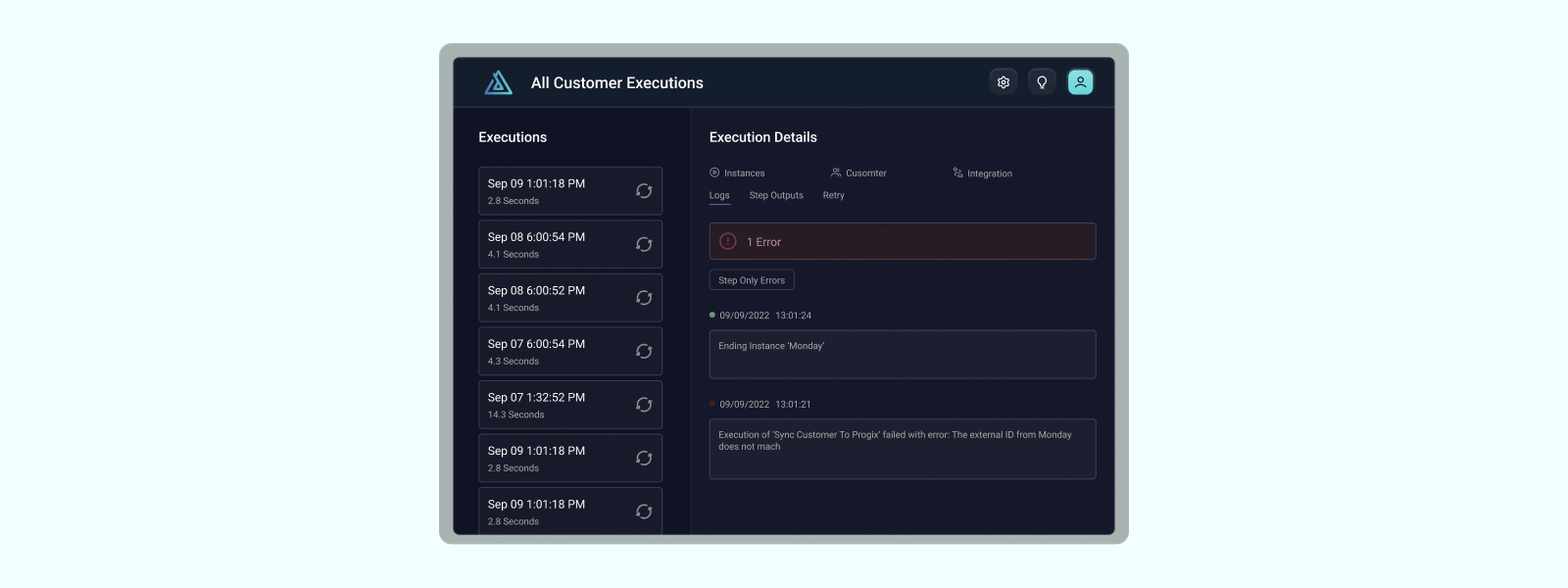
With Prismatic, you can reduce support burdens by shifting routine troubleshooting away from your teams and into the hands of your customers. The platform embeds guided self-service features, including alerting and logging that empowers customers to resolve issues independently. Monitoring and management dashboards ensure that your team has clear visibility into root causes when support is needed, enabling faster, more accurate resolutions without constantly relying on engineering. Your support organization transforms from reactive firefighting to proactive customer success, enhancing customer satisfaction.
How we help
We equip you and your team with versatile tools and the full benefits of a managed platform to streamline your integration strategy. With both low-code and code-native tools, robust config, and end-to-end lifecycle management, Prismatic enables you to deliver tailored integrations that meet customer needs – maximizing efficiency across product, engineering, and customer success teams to accelerate time-to-market and boost customer satisfaction.
Most critically, Prismatic offers a secure, scalable integration platform, freeing your team to focus on crafting business logic that drives adoption and retention, rather than wrestling with repetitive infrastructure tasks that slow down your roadmap.
Schedule a demo to see why Prismatic is the top choice for executives looking to launch integrations swiftly, scale their B2B SaaS offerings, and deliver first-class customer UX.
What to look for in an integration platform
There are many integration platforms out there, and sorting through them isn't getting any easier. The usual categories – like embedded iPaaS, enterprise iPaaS, and unified APIs – are starting to blur as more vendors rush to brand everything as "AI-driven."
That said, what features will provide you with the greatest value as an executive?
Here’s what you’ll want to look for in an integration platform:
Infrastructure
- Cloud-native architecture designed to scale for growth from startup to Fortune 500 without performance degradation
- Enterprise-grade security and compliance with purpose-built infrastructure that abstracts security concerns from users
- Multi-tenant architecture to ensure efficient resource utilization and cost optimization across customer environments
- Global availability and reliability with robust SLA commitments to support mission-critical business operations
- Vendor stability with proven market leadership and a dedicated focus on embedded iPaaS
Build
- Accelerated time-to-market, enabling teams to deliver integrations faster, reducing integration timelines from months to weeks
- Team empowerment through a dual-path approach supporting low-code (non-dev) and code-native (dev) experiences in one platform
- An extensive library of pre-built, industry-specific connectors, plus an SDK for custom connector development to reach any system
- Real-world integration complexity capability to handle sophisticated, industry-specific solutions beyond simple data syncing
Deploy
- Revenue acceleration by supporting faster sales cycles, reduced sales friction, and improved customer adoption
- Professional services enablement allowing customer-facing teams to handle deployment and configuration without engineering involvement
- White-labeled customer experience with an embedded marketplace that integrates into the existing product ecosystem
- Customer self-service activations reducing operational burden on support teams while improving customer satisfaction and time-to-value
- Differentiation through an integration marketplace that becomes a competitive moat and customer retention driver
Manage
- Customer retention optimization through increased product stickiness as integrations become embedded in customer workflows
- Visibility and control with comprehensive monitoring, logging, and analytics – providing actionable insights for strategic decision-making
- Risk mitigation through managed lifecycle updates, versioning, and support to prevent integration-related customer escalations