

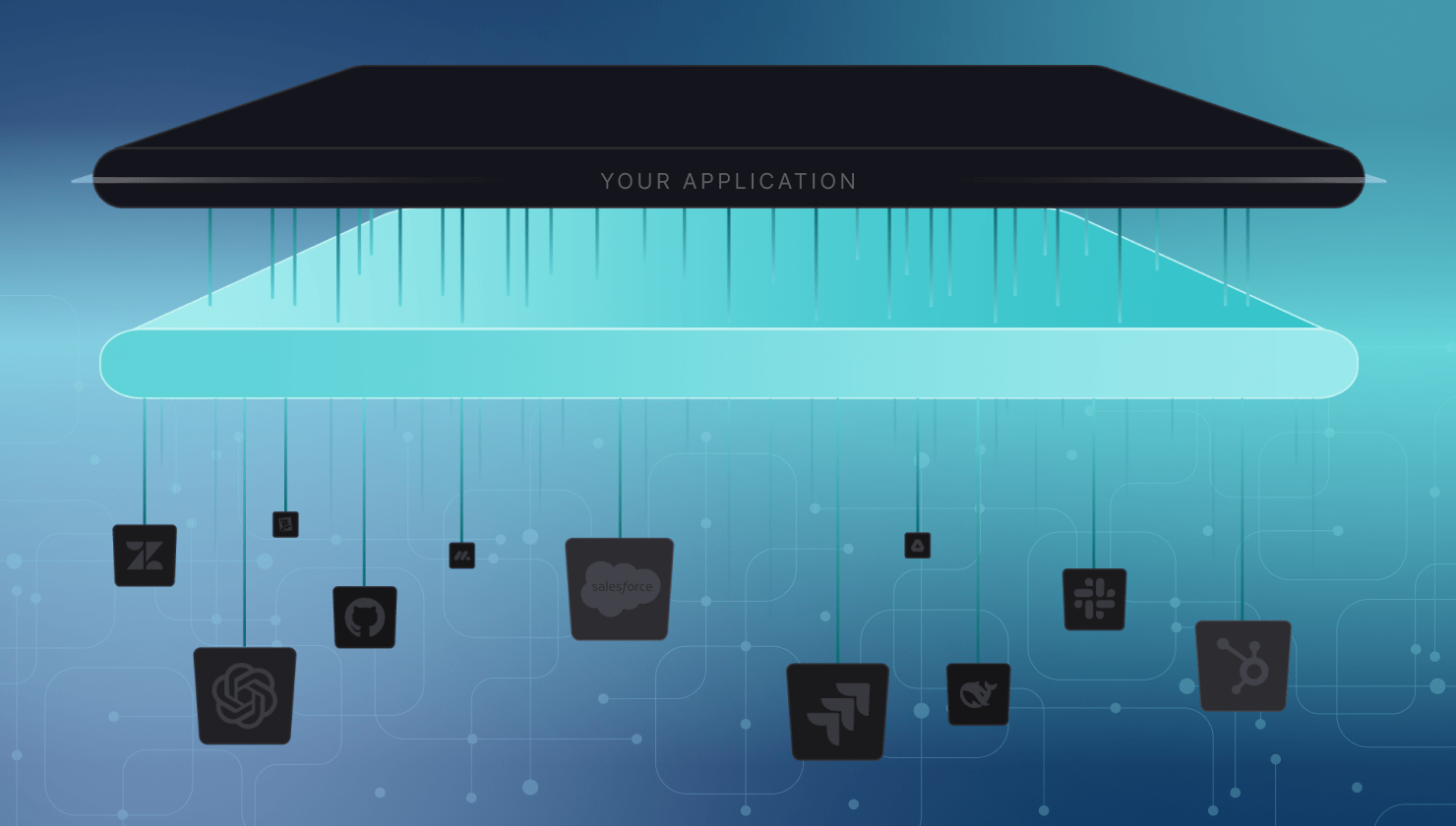
- There are five ways to connect SaaS applications: direct API builds, unified APIs, workflow automation, enterprise iPaaS, and embedded iPaaS. Each solves a genuinely different problem, and each is the wrong answer outside its specific context.
- Direct API integrations work for a handful of strategically differentiated connections, not a full catalog. Building two or three is manageable, but every API change becomes a permanent maintenance obligation.
- Unified APIs abstract multiple apps in a category behind one normalized schema. App-specific fields and custom objects get dropped in translation, and unified APIs support data sync, not multi-step orchestration or conditional workflows.
- Enterprise iPaaS tools were built for internal IT. A B2B SaaS company can't embed or white-label an enterprise iPaaS in its product, and the connector-based pricing model doesn't fit the customer integration model.
- An embedded iPaaS is the only option built for delivering integrations as native product features. It handles maintenance, self-service, and long-tail requests directly, letting customers see a live, configurable integration during a demo.
To connect with popular SaaS applications, B2B software vendors and IT teams have five main integration options. If you are integrating internal corporate systems, choose enterprise iPaaS. If you only need simple data syncing in a narrow vertical, consider a Unified API. But if you are a B2B SaaS vendor needing to deliver scalable, white-labeled, and maintainable integrations to your customers without draining your engineering roadmap, an embedded iPaaS is the only purpose-built solution.
Software buyers expect integrations. For most B2B SaaS products, the question is no longer whether to offer them, but how to offer them. And that decision matters more than most teams realize. Pick the wrong model, and you'll spend months building the wrong thing, then years maintaining it.
There are five main ways to create integrations for SaaS products: direct API integrations, unified APIs, workflow automation platforms, enterprise iPaaS, and embedded iPaaS. Each solves a different problem. Each is the wrong answer in the wrong context.
Here's how to know which one works where.
Direct API integrations
Building directly against each application's API gives your team full control. This is often referred to as in-house integration development.
And, it's the right call when you need a small number of strategically differentiated integrations, or deep access to application-specific functionality that no abstraction layer exposes. A highly customized Salesforce integration with proprietary business logic might be worth owning end-to-end.
The problem that arises is scale. Every direct integration is a permanent maintenance obligation. Every API change requires an update. Every customer issue requires engineering involvement. Building two or three is manageable. Building twenty is a nightmare problem, one that AI-assisted development can make easier (but only up front).
In-house development is right for a handful of unique integrations (particularly for early-stage startups). They're the wrong foundation for a full integration catalog.
Unified APIs
Instead of building individual connectors for every application in a category, a unified API abstracts multiple third-party systems behind a single normalized schema. For example, one integration to access Workday, BambooHR, Gusto, and Rippling. Or one schema for contacts across Salesforce, HubSpot, and Microsoft Dynamics. Providers often cover specific verticals like HR, payroll, accounting, and CRM.
This works well when your product requires standardized access to predictable data (employee records, invoices, or transactions) and the normalized model covers your needs. Fintech and HR tech are natural fits.
However, limitations show up quickly. Since the normalized schema is lowest-common-denominator by design, app-specific fields, custom objects, and niche capabilities are dropped in translation. Perhaps more importantly, unified APIs are data-sync tools, not orchestration tools. That means a Unified API doesn't support multi-step logic, conditional branching, event-driven workflows, and customer-configurable experiences.
Unified APIs can complement an embedded iPaaS, but they're not a substitute for one.
Workflow automation platforms
Tools such as Zapier and Make are built for end users who want to connect applications and automate simple workflows without writing code. They have broad connector libraries and a legitimate place in the ecosystem: internal business automation, team-level process improvements, and personal productivity.
They were not designed for software vendors building customer-facing integrations.
When your integration strategy depends on customers wiring their own Zapier accounts to your product, you've handed ownership of a critical part of the customer experience to a tool you don't control, can't brand, and can't support. That's a gap, not a strategy.
Enterprise iPaaS
Enterprise iPaaS platforms (MuleSoft, Boomi, Workato) are powerful tools for connecting an organization's internal system, such as CRM to ERP to HRIS, creating multi-step approval workflows, and building data syncs across departments. For IT teams managing internal complexity, they're a serious force multiplier.
Here's an often-missed distinction: enterprise iPaaS platforms were built to help organizations integrate their own systems. They were not built to help software vendors deliver integrations to customers.
If you're a B2B SaaS company, you can't embed an enterprise iPaaS in your product UI. You can't white-label it for customers. You can't let customers configure their own instances without significant custom engineering. And the pricing model, which is usually tied to connector usage or message volume, scales awkwardly for customer-facing integrations.
Enterprise iPaaS is the right answer for the internal IT problem. It's the wrong answer for the software vendor problem.
Embedded iPaaS
Embedded iPaaS is purpose-built for the problem enterprise iPaaS can't solve: giving B2B software vendors a way to build, deploy, and manage integrations for customers as native product features.
The difference is ownership. Integrations live inside your product, not in a third-party tool that customers log in to separately. Your customers see your branding. Your team has visibility. Your product gets the credit.
What this changes in practice:
- Maintenance – The platform handles auth, rate limiting, retry logic, monitoring, scaling, and more. When an API changes, the fix propagates across deployments so you don't need to patch dozens of individually maintained integrations.
- Self-service – Customers can enable and configure integrations within your product without filing support tickets. This lets them map fields, update auth, or set sync frequency as they need (and without engineering help).
- Sales cycles – Showing a prospect a live, configurable integration with their ERP during the demo, rather than offering airy promises of future capabilities, changes the conversation.
- The long tail – Not every integration request belongs on your roadmap. Embedded platforms like Prismatic include customer-facing workflow builders that let customers build their own connections to internal or niche systems, without your team having to build and maintain each one. We cover this in depth in Solving the B2B SaaS Long-Tail Integration Problem.
Which approach is right for you?
Are you integrating your own internal systems, or are you delivering integrations to customers?
| Approach | Built for | Embeds? | Scales? |
|---|---|---|---|
| Direct API builds | Strategic, bespoke accounts | Not usually | No |
| Unified API | Standardized data sync within a category | Somewhat | Yes (in category) |
| Workflow automation | Internal/end-user automation | No | No |
| Enterprise iPaaS | Internal IT operations | No | Somewhat |
| Embedded iPaaS | Customer-facing product integrations | Yes | Yes |
If you're running an IT team, enterprise iPaaS was built for you. If your customers’ data-sync needs are narrow and well-defined, a unified API may be the fastest path. If you're a software company that needs integrations to scale across your customer base, live inside your product, and not consume half your engineering resources, an embedded iPaaS is exactly what you need.
Check out our free trial to see what an embedded iPaaS could do for your integration strategy.