
- In-house integrations often get given away for free. Packaging integrations as product features instead lets a company restrict advanced ones to higher tiers, add usage-based pricing, or use integration depth as a natural upsell trigger.
- Customers whose data flows through multiple connected systems face real switching costs. Every sprint where an integration request loses to core product work is a bet that the customer will wait, while integration stickiness only grows the longer it runs.
- In-house teams typically spend 70% of integration engineering time on maintenance, not new development. The gap between platforms and in-house builds is invisible at integration five, but becomes impossible to miss by the twentieth.
- An embedded workflow builder absorbs the long tail of requests that could otherwise hijack a roadmap. Letting customers build workflows on top of a product turns it into a platform, which is far harder for a competitor to displace than a point solution.
You are in a meeting where the team is reviewing deals that ready to sign. Sales mentions that an important prospect has asked for a native integration between your product and a new system. The room goes quiet. The product manager looks at the roadmap. The engineering lead sighs. Everyone treats the request like a tax: a penalty your team has to pay to close a single deal.
Teams that are winning in B2B SaaS today have stopped thinking about integrations that way. They ship them faster and use them to win deals and retain customers.
The difference, in most cases, comes down to whether they're building on the right foundation: an embedded iPaaS.
An embedded iPaaS is a purpose-built platform that lets B2B software companies build integrations, deploy them at scale, and manage the whole experience natively inside their products. It handles the infrastructure (auth, logging, retry logic, per-customer configs, monitoring, and security), so your team can focus on the logic that delivers value.
Here's what that means for your company.
1. Integrations win deals before you even know it
By the time a prospect sits down for a demo, the integration question is often already answered (or wasn't), and you've already lost ground. Buyers add "does it connect to our CRM/ERP/data warehouse?" to RFPs as a qualification criterion, not a feature request. If your answer is, "Sure, we can build that," you're relying on relationship capital that your competitor (who already has the integration) won't need to spend.
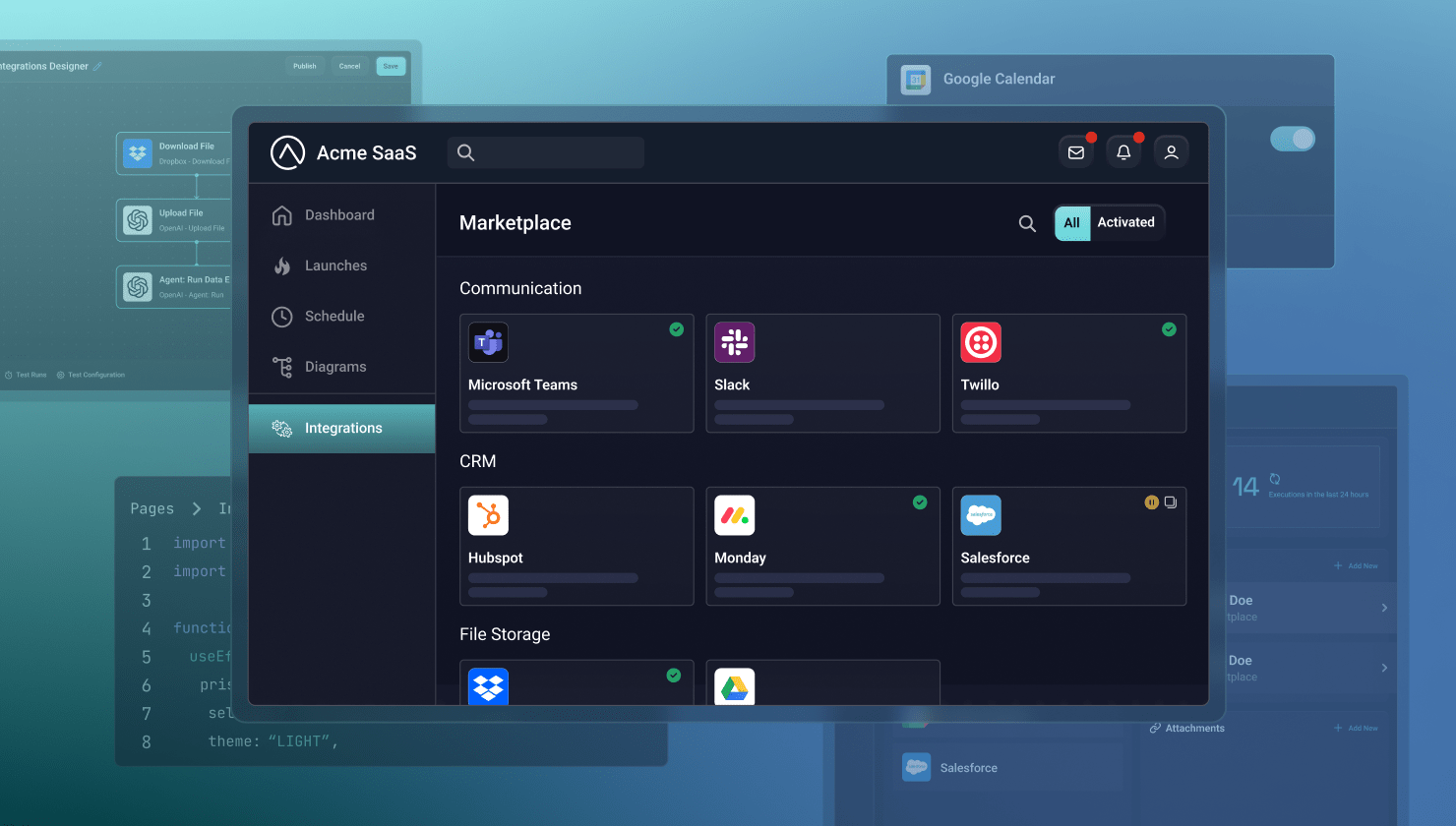
An embedded iPaaS shifts that dynamic. Instead of promises, you show a live, in-product integration marketplace that prospects can see for themselves. Your solutions engineering team can say yes on the first call instead of routing requests to a "maybe in Q3" conversation with engineering.
Prismatic customers have reported up to a 5x increase in ARPU after deploying an integration marketplace because integrations are proof points that your product fits the way your customers work.
2. Integrations are a revenue line, not just a cost line
When integrations are built in-house, they tend to get buried in the backend and given away for free. As a result, you absorb 100% of the development and maintenance costs while capturing none of the possible market value.
An embedded iPaaS changes the equation. When integrations live inside your product as product features, you can package them like any other feature: restrict advanced integrations to higher tiers, add usage-based pricing on top, or use integration depth as a natural upsell trigger.
The shift from "integration as infrastructure" to "integration as product feature" is one of the better ways a B2B SaaS company can improve ARPU without adding headcount.
3. Integrations retain customers better than almost anything else
Once a customer's data flows through your product into their CRM, their ERP, and their analytics stack, switching gets expensive. In addition to switching out your product, they would need to restructure workflows, re-map data, and reconnect with every system your product connects to.
The inverse is also true: customers who never get the integration they need don't fully embed your product into their workflow, receive less value, and leave when a competitor arrives with a better integration story.
Every sprint cycle in which integration requests lose to core product work is a bet that the customer will wait. But integration stickiness grows over time. Each integration you ship is another thread connecting your product to your customer's workflow.
4. Speed compounds, but so does falling behind
Teams that build integrations in-house typically spend 70% of their integration-related engineering time on maintenance, monitoring, and debugging rather than shipping new value. The OAuth flows are rebuilt from scratch on every integration. The webhook handlers break every time a third-party API changes.
An embedded iPaaS inverts that ratio: the platform handles the infrastructure, your team writes the business logic, and reusable components make every subsequent integration faster than the last. Teams that build in-house get slower over time. The gap is invisible at integration five, but by the twentieth integration, it's become impossible to miss.
5. You can scale integrations without scaling headcount
An embedded iPaaS writes integration logic once and manages customer-specific configuration (credentials, field mappings, and endpoints) in a per-tenant layer that the platform handles. Deploying the same integration to a new customer is a brief configuration exercise, and not a lengthy development project.
Customer success can deploy existing integrations without filing tickets with engineering. Support can diagnose failures from execution logs without pulling anyone off the roadmap.
Technical support staff configure new instances of known integrations; software engineers get involved when there's something new; support staff can monitor what's happening day-to-day. Meanwhile, we can focus engineering cycles on adding value for our customers.
That's what the right platform makes operationally possible.
6. Letting customers build becomes a competitive moat
The teams that have turned integrations into a real competitive advantage are doing so in part by letting customers build workflows themselves. An embedded workflow builder deployed inside your product handles the long tail of one-off requests that would otherwise hijack your roadmap: the niche ERP, the legacy system, the internal tool nobody outside that company has ever heard of.
More strategically, products that let customers build workflows on top of them become platforms, and platforms are much harder to displace than point solutions. Enterprise buyers often want to own their integration logic. For them, an embedded workflow builder can be what moves you from the shortlist to the selected list.
Stop paying the integration tax
If integration requests keep showing up in your lost-deal analysis, if engineering is spending more time maintaining old integrations than shipping new ones, or if customer success can't answer "When will my integration be ready?" without asking engineering – then you've already hit the point where the cost of staying on the current path outweighs the cost of changing it.
Integrations built as infrastructure become a maintenance problem. Integrations built as a product capability (deployed natively, accessible via a marketplace, monetized through your pricing model, and highly configurable by customers) become a growth driver. The underlying technology is often similar, but the business outcomes are not.
And that's why an embedded iPaaS is what helps you stop paying that tax.
Ready to see how Prismatic fits into your stack? Start a free trial or get a demo from our team.