

- Visible business logic is about 20% of a typical integration build. The other 80% covers security (OAuth, token refresh), resilience (retries, backoff), observability (logs, alerting), and deployment (per-customer config, versioning).
- A low-code builder reduces code written, but has serious limitations. Every visual builder eventually hits the same wall (a complex transformation or unique API) at which point devs either wait on the vendor or work around the tool.
- Code-first development on existing infrastructure turns weeks of work into days. AI tooling built for the platform lets a dev describe an integration in plain language and get working, pattern-matched code in minutes.
- Creating integrations as reusable product features compounds velocity. Every integration built on existing auth, reusable components, and built-in tenant isolation ships faster than the last.
- Customers activating integrations themselves is huge. No support ticket or engineering involvement is needed, and guided wizards let non-technical staff handle customer-specific setup.
Your biggest prospect wants a Salesforce integration. Engineering estimates eight weeks. Sales asks if there's any way to speed things up.
At this point, most teams reach for one of two answers: build from scratch in-house, or do the work with a low-code builder. But neither solves the velocity problem. Building from scratch is a terrific way to go slow – there's no way to build from scratch and go fast without funding a large, expensive team whose full-time job is maintaining integration infrastructure. And forcing devs into a visual builder trades a couple weeks of ramp-up speed for a logic ceiling they'll hit faster than you are expecting.
The teams that accelerate time-to-market for B2B SaaS integrations do something different: keep engineers in code, give them AI tooling built specifically for integration development, and get finished work in front of customers through a marketplace instead of a support ticket.
Why integrations take longer than estimated
When engineers estimate an integration, they're estimating the part they can see: receive a payload, transform the data, and send it elsewhere. That looks like a two-week job. And it would be, if that's all there were.
In practice, that business logic is maybe 20% of the work. The other 80% (that didn't make it into the planning doc)? That includes:
- Security – OAuth flows, token refresh, and multi-tenant segregation.
- Resilience – Retries, backoff, rate limits, and circuit breakers for third-party downtime.
- Observability – Execution logs, audit trails, and monitoring and alerting dashboards.
- Deployment – Per-customer config, environment isolation, versioning, and rollbacks.
None of this makes your product obviously better for customers. But it's the cost of shipping integrations that work reliably, whether it's your first or your fiftieth. Feature velocity slows down because every custom integration adds to the ongoing burden of maintenance, monitoring, and third-party breaking changes.
Why low-code isn't the shortcut it looks like
Low-code builders are the easy answer for simple workflows, but they only make up a small percentage of B2B SaaS integrations. In addition, devs usually optimize processes around their IDEs, Git, code review, and CI/CD pipelines. The drawback of a visual-only environment is that it removes those tools without reducing the underlying work.
Every visual builder eventually hits the same wall: a complex data transformation, a non-standard auth scheme, or conditional logic the builder doesn't enable. At that point, devs are either waiting on the vendor or working around the tool. Debugging a visual flow with no real version control is harder than debugging code you can review, test, and roll back. Low-code reduces how much code you write, but it doesn't reduce how much engineering the integration requires. Unfortunately, some of the required engineering ends up as workarounds for the builder.
Go code-first with an AI assist
Since building from scratch is slow and low-code has a ceiling, what's the answer? In some ways, it may seem like we are going backward, but it's not. The answer is that devs write real code on infrastructure that's already solved 80% of the need, with AI tooling that understands the platform and the problem. Here's how it works:
- Start with infrastructure you don't have to build. A purpose-built embedded iPaaS like Prismatic abstracts the plumbing – auth, retries, rate limiting, execution logs, staging, and deployment. It's taken care of before you begin.
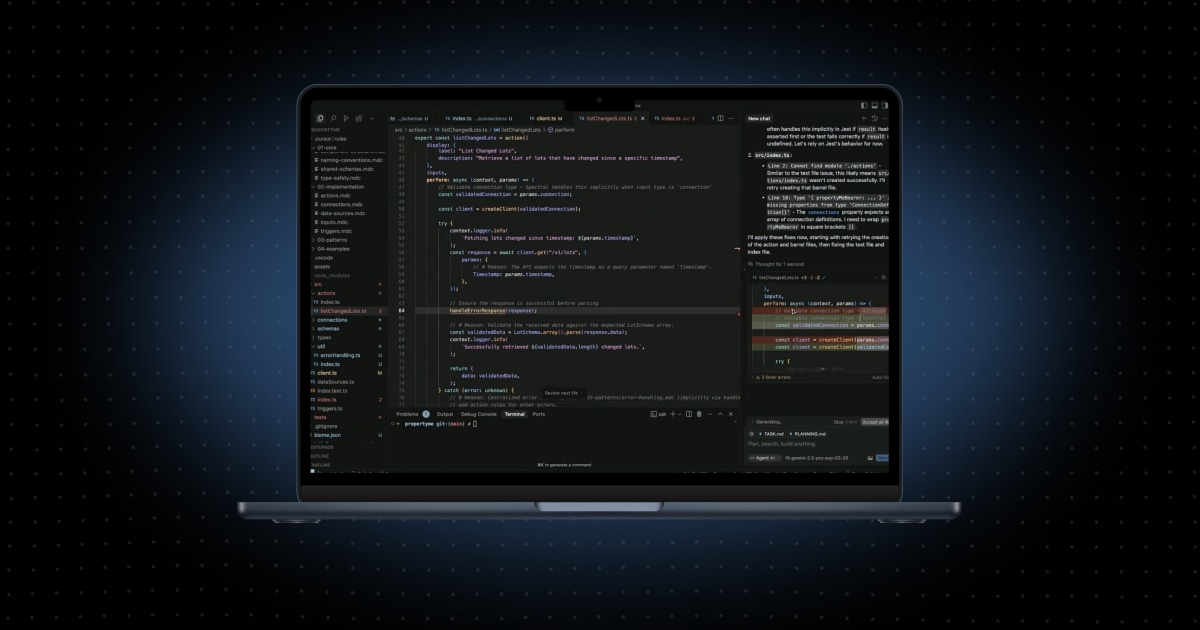
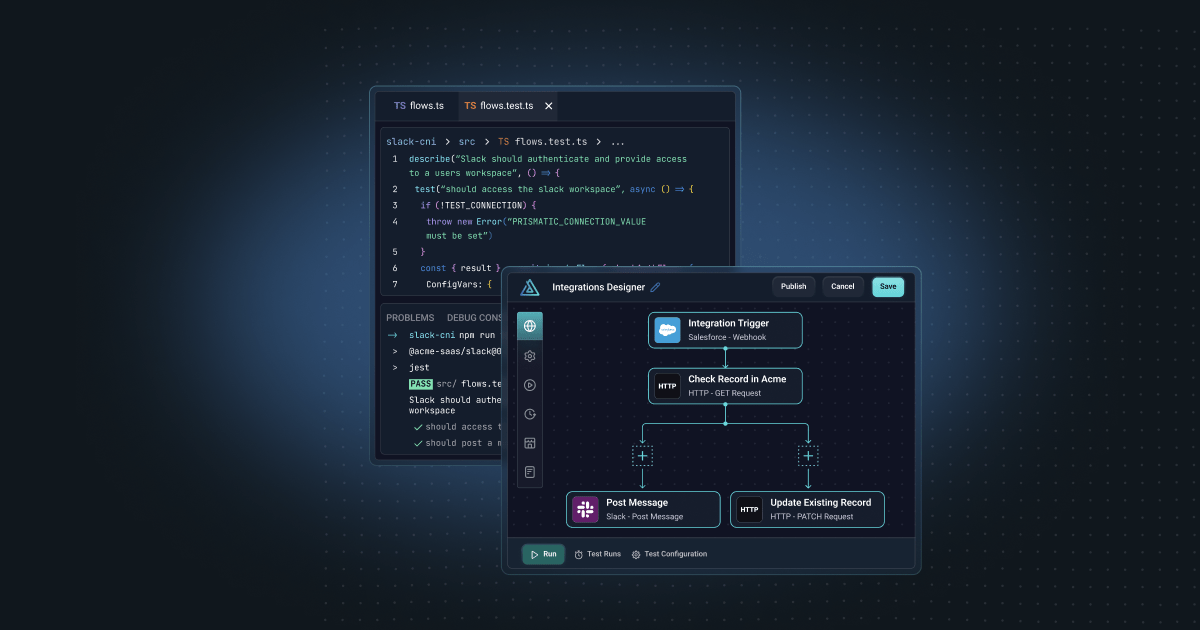
- Let devs write TypeScript in the tools they already use. Prismatic's code-first integrations run in your developers' IDEs and deploy through your existing CI/CD pipeline, not a browser-based designer that lives completely outside your normal dev process.
- Use the AI tooling built for this job. Prismatic Skills give AI assistants like Claude Code deep knowledge of Prismatic's SDK and component patterns, so a dev can describe an integration in plain language and get something that works (and matches existing patterns) in a few minutes. Prismatic's MCP dev server connects that same assistant directly to your Prismatic environment, so it isn't hallucinating APIs that don't exist. Then, the workflow is: describe the requirement, AI scaffolds it, review the business logic, deploy through CI/CD. Work that took weeks now takes days, and because everything is TypeScript, there's no low-code ceiling to run into.
Reusability adds up
The teams with the best long-term velocity are those who have figured out how to write less new code because auth is solved, components are reusable, and tenant isolation is built into the integration platform. This approach requires that you treat your integrations as legit product features instead of one-off projects that are forgotten after a single customer. Every integration you ship should make the next one easier.
Shipping code isn't the finish line
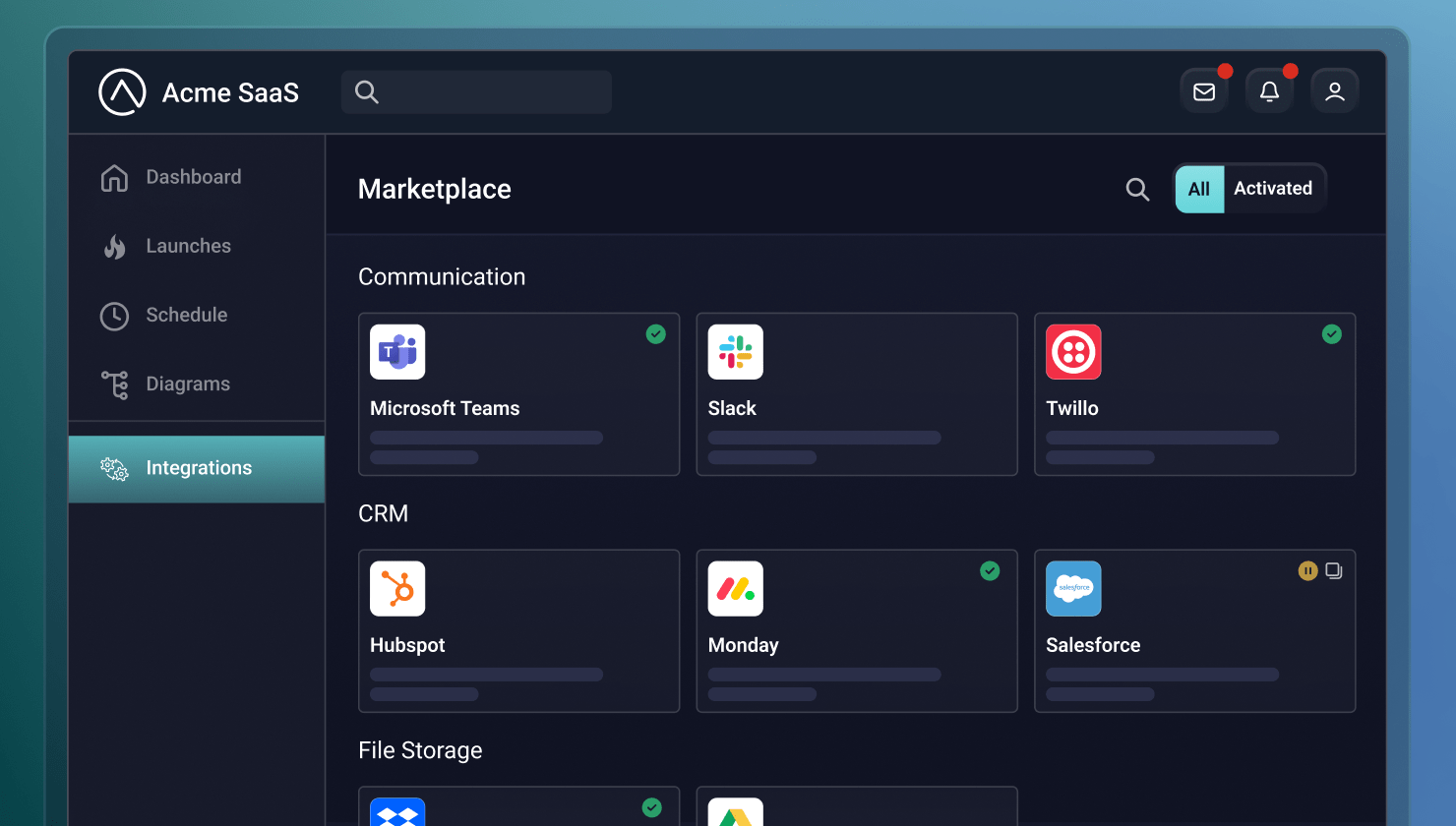
Integration value arrives when customers are using it. That's why a white-labeled integration marketplace is a key part of increasing velocity. It shortens the distance between "integration complete" and "integration providing value." Customers can discover, configure, and activate integrations themselves, with no support ticket and no engineering involvement.
Guided wizards let non-technical staff activate integrations that need customer-specific setup, so engineers aren't the deployment bottleneck. Sales gets a live catalog instead of a slide, and marketplace activity provides all sorts of data to help you determine what to build next and where you need further refinements. The marketplace increases velocity by helping your work start paying off now rather than later.
A few practical steps
- Start with infrastructure you don't have to build – let a purpose-built platform handle auth, retries, logging, deployment, and more.
- Give engineers AI tooling that understands the platform – Prismatic Skills and the MCP dev server with Claude Code.
- Write in code and reserve visual tooling for prototyping and simple scenarios.
- Build for long-term reuse and not one-off delivery.
- Use a white-labeled marketplace to ensure integrations reach customers the day they're ready to use.
- Track delivery, not just development. Time to production and activation matter more than lines of code.
Time-to-market is an architecture problem
The struggle is not between "no code" and "some code." It's about how much of your engineers' time goes toward plumbing, versus business logic – and whether the integration you just shipped can reach a customer without another ticket in the queue.
Ready to see it in practice? Start a free trial or get a demo and see how Prismatic Skills, the MCP dev server, and a white-labeled marketplace fit into your stack.