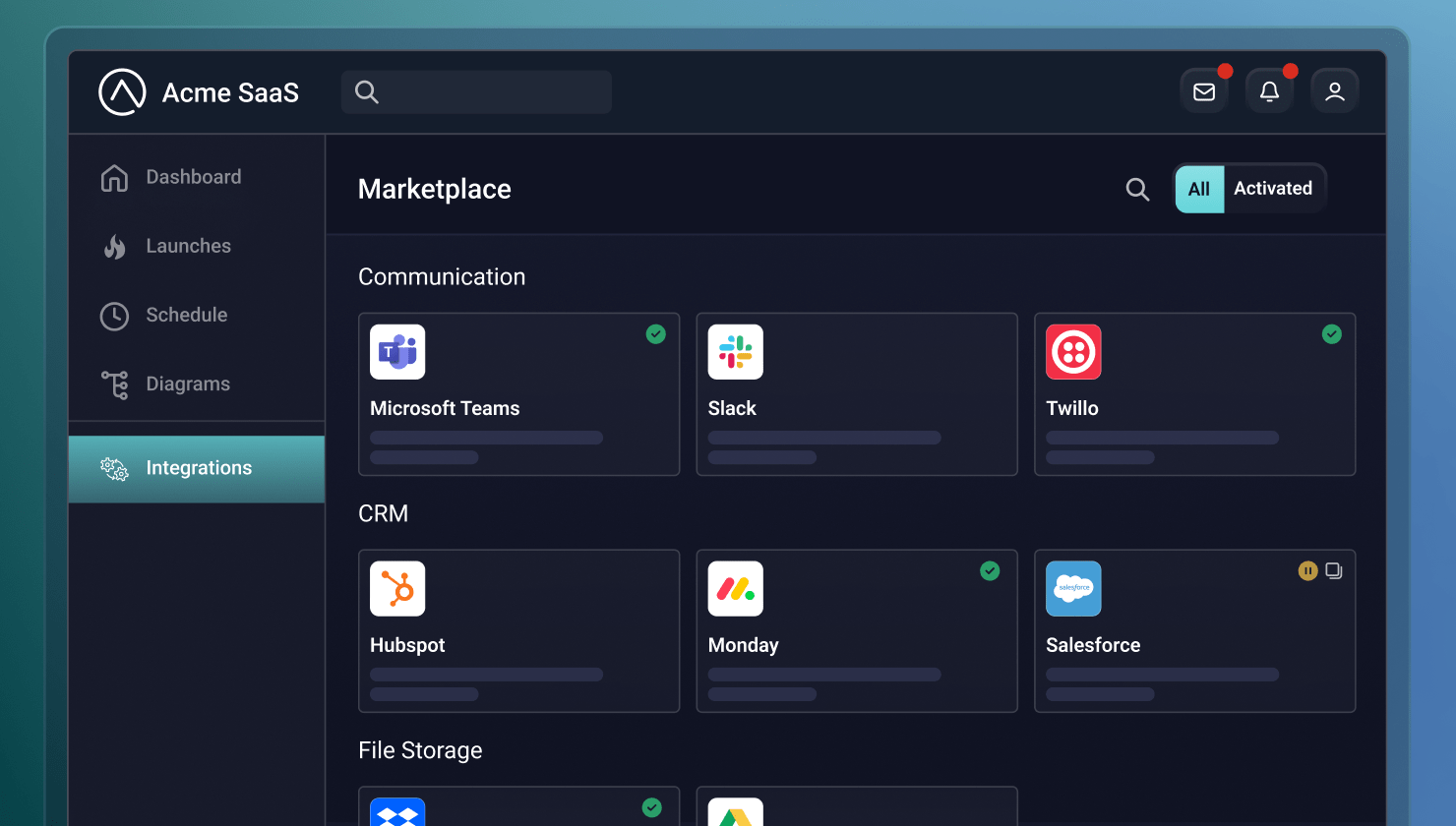


- "Integration marketplace" can mean one of three things. Static directory pages are lead-generation forms with no working integrations; link-out directories send customers to a third-party portal; and only an embedded marketplace keeps customers inside your product.
- A proper marketplace blends in so customers are unaware of the third party. They authenticate, configure, and activate entirely inside the product.
- Ten customers needing engineering involvement means ten configuration projects, and a second integration doubles that. Productized integrations backed by self-service break that pattern, since a team builds once and customers activate their own instances.
- A marketplace becomes relevant once several signals show up together. When integration requests outpace what tickets can handle, prospects ask where integrations live in the product, and CS spends time on activations instead of troubleshooting.
Your prospect asks whether customers can configure and manage the Salesforce integration right inside your app, or whether they'll need custom webhooks and an external portal.
Sales checks into it with product. Product forwards the question to engineering. Engineering starts mentally figuring out what it would take.
Somewhere in that process, someone eventually asks, "Is there a solution that does this, or do we need to build this ourselves?"
The simple answer is yes, there is a platform that does this.
In-app, self-service integration marketplaces aren't custom engineering projects you must invent from scratch. These integration hubs, where customers discover, configure, and activate integrations from inside your product, are a mature, production-ready capability. Companies are running them today.
If you're still skeptical, it's probably not because the technology doesn't exist. But it could be because the market has spent years muddying the meaning of "in-app marketplace."
Why the question keeps coming up
Go looking for an integration marketplace, and you'll run into at least three different things with that name:
- Static directory pages. Rows of logos with a "Contact Sales" button next to each one. It looks like a marketplace. But it's a lead generation form. The integrations don't exist. Or, if some do, they are as simple as they can be.
- Link-out directories. A list of integration cards that sends the customer to a third-party portal to finish setup. This is closer to what you need, but the moment a customer leaves your domain, you no longer own the relationship or drive the UX.
- Embedded marketplaces. A native, white-labeled UI built directly into your product. The customer authenticates, configures, and activates the integration without leaving your app.
When someone realizes most "marketplaces" are the first two, it's a fair jump to assume the third has to be custom-built. It usually isn't, but traditional (or enterprise) iPaaS doesn't help make things clearer. Enterprise iPaaS platforms were built for internal IT teams connecting app A to app B behind their own firewall, not for a SaaS company shipping integrations to hundreds of external customers with their own credentials and permissions. Enterprise iPaaS has no multi-tenancy, no white-labeled components, and no obvious way to slip a marketplace into your app. So, if you've looked at enterprise iPaaS for integrations, it's reasonable to conclude that an integration marketplace with proper customer self-service must be custom-built.
But don't give up hope quite yet.
How the concept of the integration marketplace evolved
Integrations didn't start as customer-activated features. Early on, a marketing page said "we integrate with Salesforce," and getting one live meant a support ticket and a few weeks of back-and-forth. The integration existed, but it didn't have a simple "on" switch.
As catalogs grew, integrations became more standardized, built once and configured per customer instead of built from scratch each time. That created an opportunity. If an integration knows what it needs from a customer, then we don't need CS to collect that information manually.
And that's why that opportunity has matured into the self-service marketplace. A customer opens the integrations section of your product, selects what they want, authenticates, configures the options that matter to them, and activates it.
As a result, the integration moves from something your team deploys for the customer to something the customer turns on inside the product*.* This aligns with buyer expectations set by market leaders like Salesforce with its AppExchange and Shopify with its App Store.
Real companies are already running these marketplaces
Hatch found customers were eager to configure and activate integrations themselves once that option existed inside the product.
Karbon scaled its catalog from 30 to 75 integrations without adding integration headcount, because catalog growth no longer required team growth.
None of these companies became integration-platform companies to get there. They put the customer-facing experience inside their own product while running purpose-built infrastructure underneath it.
The platforms built for exactly this are embedded iPaaS: a back-end platform to run customer-facing integrations at scale, paired with the frontend pieces needed to present a native marketplace inside your app.
What this looks like for a customer
A good embedded marketplace isn't exciting (nor should it be). Suppose your product integrates with Salesforce. A customer signs in to your app, opens the integrations section, searches for Salesforce, and clicks "Connect." They're routed through the Salesforce auth flow and sent back into your product. Next, they handle the config: which records will sync, what's the data mapping, and how often does the integration run? They answer, click "Activate," and the integration is live.
At no point did that customer need to know an embedded iPaaS was involved, hold credentials for a separate tool, or file a ticket. As far as they're concerned, Salesforce connectivity is a feature of your product.
That's also the test for whether something calling itself a marketplace behaves like one. Does it live inside your product under your branding, use your authentication, and let customers reconfigure and troubleshoot on their own once things are set up? If any of those things get routed back through your team, then the "marketplace" may be a directory with slightly better styling.
Why the economics matter, too
Building an integration is part of the cost of offering it to your customers. Deploying and managing are the other parts, and those are the parts a marketplace changes. If every new customer needs engineering involvement to turn an integration on, your cost keeps growing alongside your customer count because 10 customers can mean 10 configuration projects, and a second integration means 20 config projects. And then there's the maintenance.
Productized integrations, backed up by customer self-service break that pattern. Your team builds them once, with configuration options to account for how customers normally differ. Then, customers activate their own instances and handle common issues with them when they arise (and without engineering). That's why embedded marketplaces show up as catalogs grow: the UI enables self-service, but the shift away from custom deployment makes self-service activation, configuration, and management pay for itself many times over.
Signs your product is at that point
A marketplace tends to become relevant once a few signals show up together:
- Integration requests are growing faster than your team can fulfill via tickets
- Prospects are asking where integrations live inside your product rather than whether they exist
- Deals are stalling because your integration UX looks clunky next to a competitor's
- CS is spending substantial time on integration activations instead of troubleshooting
An early-stage product with a handful of simple integrations probably doesn't need to solve this yet. However, if two or three of those signals sound familiar, it's time to implement a marketplace for your integrations.
The bottom line
In-app marketplaces for integrations aren't a hypothetical or a feature you're stuck building from the ground up. They're a mature capability with a dedicated platform category and real companies running them in production.
Ready to compare vendors? Or would you like to see one running instead? Start a free trial and try Prismatic's embedded marketplace inside your own app.