

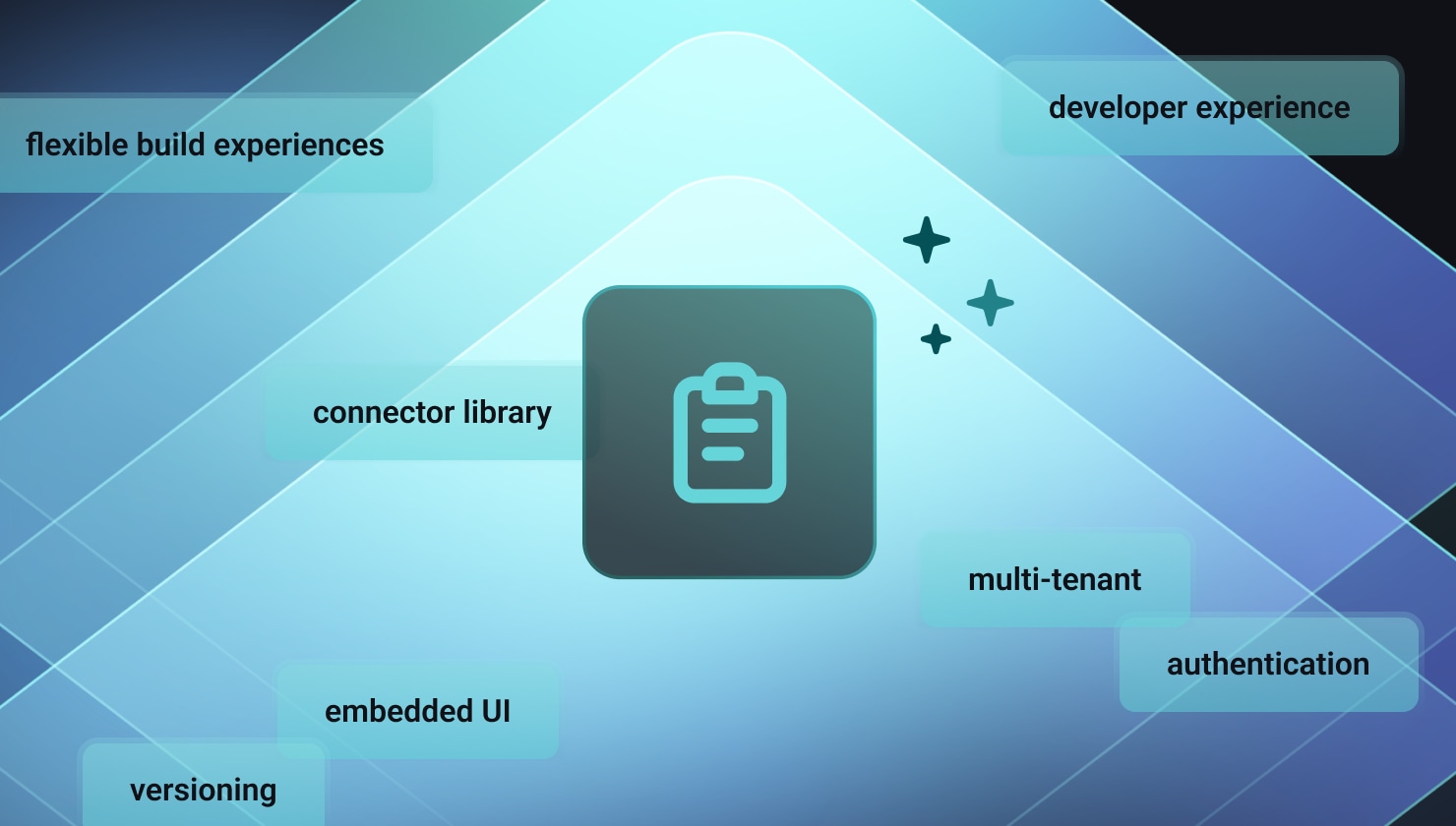
- A code-first platform backed by a low-code builder means neither devs nor non-devs are second-class. Devs write full TypeScript with local testing and version control, while the same 190+ components power a low-code designer.
- Managing credentials for hundreds of instances is quite different from managing one. Per-tenant credential isolation, built-in OAuth flows, and automatic detection of failed connections need to be platform-level guarantees.
- A "build once, deploy to thousands" model breaks the linear relationship between customers and engineering load. One integration definition carries customer-specific credentials and configuration without copying integration code between customers, and CS teams deploy it through a configuration wizard.
- Isolated, multi-tenant execution environments prevent one customer from affecting another. Every platform looks similar in a sandbox, but the differences show up once thousands of concurrent instances, rate-limited APIs, and webhook spikes hit production.
- Exposing structured flows rather than raw API endpoints is what makes agentic access production-safe. An agent calls a bounded flow like "update CRM record." The platform handles auth, sequencing, and retries, with the same isolation and alerting that catches a failed sync also catching a failed agent-triggered flow.
An engineering team picks an integration platform, gets a few integrations live, and declares victory. Six months later, they're back in a problem they recognize: engineering is fielding support tickets about failed syncs, CS is waiting on devs to reconfigure instances for new customers, and the roadmap has filled up with maintenance work that nobody expected.
The platform didn't fail them, exactly. But it's likely it wasn't built for what they needed.
Most teams evaluate integration platforms on build speed. That's a reasonable starting point, but the question that matters more is whether the platform can support integrations at scale across hundreds of customers, be proactively monitored, and be maintained by more than just the engineer who originally built them.
Here's what to look for in an integration platform.
01 Flexible build experiences for every team member
Low-code-only platforms will let you down when requirements get complex. Code-only platforms require engineering for every deployment and support request. Prismatic takes a code-first approach but backs it with a powerful low-code builder, so neither path is ever second-class. Devs write full TypeScript in their IDEs using the code-first SDK, with local testing, version control, and direct access to our library of 190+ open-source components.
Those same components power the low-code designer, which gives CS teams and non-devs the ability to build and modify integrations without touching code. Then there's the question of whether customers can build their own workflows within your product. Prismatic's embedded workflow builder puts that capability directly in their hands.
02 A connector library that goes beyond the obvious
Pre-built connectors handle auth, pagination, rate limiting, and common API patterns so you're building integration logic, not plumbing. But your customers don't all use the same tools, and no connector library can do everything.
If your platform doesn't provide a simple path to custom connectors, every unsupported system becomes a platform limitation. That's why Prismatic's connector library is fully open-source, and the custom connector SDK lets developers build reusable Node.js/TypeScript modules for any API, extending that same connector library.
03 Managed authentication at scale
Managing OAuth tokens, API keys, and credentials across hundreds of customer instances is a fundamentally different problem from managing them for a single instance. Tokens expire, keys are rotated, and connections may fail without notice.
A platform that handles auth properly treats it as infrastructure rather than integration logic (with per-tenant credential isolation, built-in OAuth flows, and automatic detection of failed connections). Prismatic catches connection exceptions via alert monitors before customers do, and SOC 2, GDPR, HIPAA, and CJIS compliance come as platform-level guarantees, not engineering tasks.
04 Multi-tenant deployment without engineering involvement
If deploying an integration to a new customer requires an engineer every time, you've created an unsustainable linear relationship between customer count and engineering load. You don't want to do that. Instead, use a "build once, deploy to thousands" model: one integration definition, configurable per customer, deployed without dev involvement.
Prismatic instances carry customer-specific credentials and configuration without copying integration code between customers. Configuration wizards give CS teams the tools to handle deployments on their own. The embedded marketplace lets customers self-activate integrations directly within your product.
05 Execution infrastructure built for integration workloads
Every integration platform looks similar in a sandbox. The differences appear once integrations are in production and the platform is handling bulk API syncs, thousands of concurrent customer instances, rate-limited third-party APIs, and sudden webhook spikes. A platform built on shared compute can fall apart the first time two high-volume customers run batch jobs simultaneously.
Prismatic provides isolated, multi-tenant execution environments with message queueing, concurrency controls, and automatic back-off. A runaway process in one tenant doesn't affect another, and transient failures are managed without manual intervention.
06 Versioning and integration lifecycle management
Integrations don't stay finished. APIs change, endpoints are deprecated, and auth methods evolve. Every integration you ship comes with a long-term maintenance commitment. And, without proper change management, it becomes significantly more expensive. Your platform should support versioning for integrations and components, let you push updates to subsets of customers before rolling them broadly, and allow enterprise accounts to stay pinned to stable versions.
In Prismatic, integration definitions live in version control and deploy via CI/CD pipelines, so changes move through testing and staging before reaching production customers.
07 Proactive monitoring and execution observability
The integration platforms that create the most operational pain aren't the ones with the most bugs; they are the ones where customers see problems before you do. Prismatic's configurable alert monitors trigger on execution failures, duration thresholds, connection exceptions, and missed schedules, routing notifications to any webhook-compatible destination.
Detailed per-step execution logs give teams the information to diagnose failures in minutes rather than hours, and streaming logs to observability platforms means integration health appears alongside your product metrics. Customers can also access their own logs, resolving issues without opening a ticket.
08 Programmatic control and developer experience
If everything requires a click in a GUI dashboard, you can't automate your delivery pipeline. The Prism CLI and a strongly typed GraphQL API expose every platform operation (provisioning customers, configuring instances, deploying updates, and pulling logs) so your team can automate whatever the pipeline requires. Integration code lives in Git.
GitHub Actions handle publishing and deployment. And Prismatic Skills for Claude Code gives AI coding agents deep platform-specific knowledge, so generated code reflects standard integration patterns.
09 An embedded experience that feels like your product
Customers increasingly expect integrations to be part of the software they purchase and not a separate portal or a UI that breaks the visual language of your product. Integrations buried in a settings menu are ones customers don't know you have.
Prismatic's embedded marketplace and SDK deliver a fully white-labeled integration experience (discovery, activation, configuration, and monitoring) living inside your product, not alongside it.
10 Built for agentic workflows
Many agentic integrations never make it out of the sandbox because an agent that calles API endpoints directly is easy to prototype but fails in production because it lacks guardrails and unequivocal instructions.
Prismatic's MCP flow server solves this by exposing structured flows rather than individual API endpoints. You mark specific flows as agentic (a bounded unit of work like "update CRM record") and toggle which ones an agent can call. The agent calls the flow and Prismatic handles authentication, sequencing, retries, and more behind the scenes.
That structure is what makes agentic access safe to hand to customers, not just internal teams. An AI agent embedded in your product can call a flow to act across a customer's connected systems within the conversation itself (updating a CRM record, enriching a lead, or kicking off a multi-system update from a natural-language request) using only integrations that the customer has enabled. Each flow runs in the same isolated, multi-tenant environment as the rest of your integrations, so an agent acting for one customer can't spill into another's data, and the same alerting and logging that catch a failed sync will catch a failed agent-triggered flow.
The platform for the integrations
Most integration programs don't struggle because teams can't build integrations. They struggle because they can't efficiently support, maintain, and evolve them as demand grows.
Picking the right platform is a decision about what your team will own versus what the embedded iPaaS will own. Prismatic is purpose-built for B2B software companies. It handles the infrastructure that breaks at scale, leaving your team to work on the integration logic that creates value for your customers.
Start a free trial or get a demo to see how Prismatic handles these features in practice.