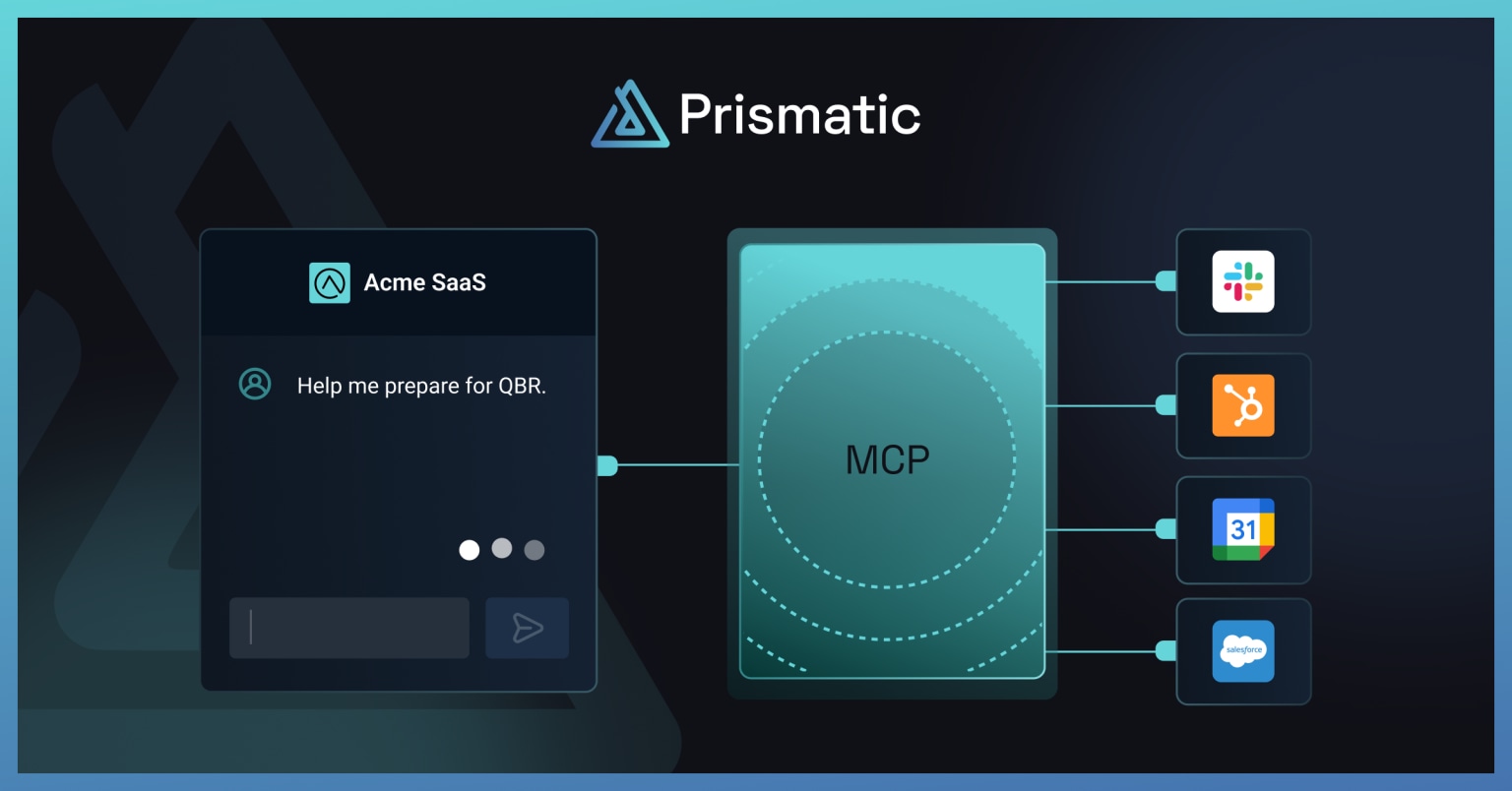
- MCP sits above APIs instead of replacing them. A common architecture runs an AI agent, an MCP server, integration logic, an API, and an application.
- The AI selects the capability; workflows execute it. A wrong-product replacement belongs in one workflow exposed as replace_customer_order.
- Tool descriptions and results influence the model's next action. Keep credentials out of the model's context, expose only necessary tools, scope access to the customer, validate inputs, and require approval for high-risk actions.
It will come as no surprise for us to note that AI agents are changing how software systems connect. Traditional APIs still power most integrations, but they were not designed for a model that discovers tools at runtime and decides what to call based on natural language.
The Model Context Protocol (MCP) addresses that need by giving AI agents a standardized way to discover and invoke capabilities.
MCP servers often use APIs behind the scenes. The difference is largely about the consumer: APIs are built for software that already knows what to do; MCP is built for AI agents that need to discover what they can do.
APIs are built for known interactions
If your application needs to create a contact in HubSpot, it can call the HubSpot API. Your code determines:
- Which endpoint to use
- Which parameters to send
- How to authenticate
- What to do with the response
- How to handle failures
That makes APIs well suited to deterministic software-to-software communication.
If your application receives a new user and should create that user in another system every time, you do not need an AI agent to decide what happens next. Rather, you need software that follows the rules you wrote.
With an API, discovery is usually design-time work. A developer reads the documentation or OpenAPI specification, implements a client, and codes the required calls.
MCP is built for AI agents
Now imagine that your SaaS product includes an AI assistant. One of your customers asks the assistant to:
"Find John Bergeron in HubSpot and tell me which company he works for."
You could write logic to cover every way in which that request might be technically expressed. Or you could give the agent a tool to find HubSpot contacts.
When an AI agent connects to an MCP server, it can discover available tools, read their descriptions and input schemas, and choose the tool that best answers the user's request.
That is a different interaction model from a traditional API. The application does not always know the operation in advance. The AI interprets the request, selects an available capability, and supplies structured inputs.
Who decides what to call?
Consider this possible request from a customer:
"I received the wrong product. Send me the correct one and let me know when it's on the way."
Resolving it might require your software to:
- Find the customer and order
- Verify replacement eligibility
- Create a return record
- Check inventory
- Create a replacement order
- Retrieve shipment information
- Notify the customer
You could implement that process with APIs, but your application owns all the sequencing and error handling.
You could also expose each operation as an MCP tool and let the agent assemble the process. However, that is usually a poor design for a critical workflow since the agent is likely to guess wrong (because it lacks context).
A better approach is to build the replacement process as a deterministic workflow and expose it as one MCP tool, such as replace_customer_order.
The AI determines which approved process applies. The predefined workflow handles the execution.
Using MCP means letting the AI select a capability while deterministic software handles authentication, validation, transformations, API calls, branching, retries, and business rules. That is, everything that shouldn't be guessed.
MCP tools should expose outcomes, not every endpoint
You could turn every API endpoint into an MCP tool, but you don't need to.
API endpoints are designed for programmatic access to resources and operations. MCP tools should be designed around the outcomes an AI agent needs to deliver.
Suppose your customer asks:
"How many high-priority Zendesk tickets are currently open?"
You could expose tools for listing tickets, retrieving details, filtering results, and handling pagination. Or you could expose a tool called get_open_ticket_count_by_priority that handles that work.
The second approach is easier for an agent to use and keeps integration logic in code you can test, monitor, and maintain.
A good MCP tool should have:
- A clear, task-oriented name
- A description that explains when to use it
- A strict input schema
- Explicit side effects
- A focused, useful result
MCP makes capabilities discoverable, but your engineers get to decide which capabilities the agent can discover.
MCP does not make execution nondeterministic
The AI may choose which tool to invoke, though the tool's execution can still be deterministic.
- Let the AI interpret intent and select a capability.
- Let deterministic software execute the business process.
This matters for B2B SaaS integrations. You probably do not want an LLM improvising calls for five third-party APIs every time a customer asks a question. You want it to invoke a tested capability that handles those details reliably and consistently.
The AI agent also affects the security model. Tool descriptions, tool results, and the available tool catalog can influence what the model does next. Keep credentials out of the model's context, expose only necessary tools, scope access to your customer, validate inputs, and require human-in-the loop actions when appropriate.
MCP does one job; an API does another
A common architecture looks like this:
AI agent → MCP server → integration logic → API → application
The MCP server gives the AI agent a standardized way to discover and invoke a capability. The integration handles the logic. The API remains the piece needed to interact with the application.
Use an API when the caller already knows what operation to perform. For example, if a Salesforce webhook should create a project in your product, the event and action are known. An API is the natural choice.
Use MCP when an AI agent needs to interpret a request, choose among available tools, and invoke the one that fits the best. Examples include:
- Which Salesforce opportunities are closing this month?
- Show me the Zendesk tickets associated with Acme.
- Schedule a follow-up with everyone who attended yesterday's demo.
Most modern applications use both approaches, and that's how it should be.
Prismatic's two MCP servers
Prismatic has two MCP servers because they solve two different problems at different points in the integration lifecycle.
The MCP dev server helps AI build integrations
The MCP dev server is a local development tool for AI coding assistants such as Claude Code, Cursor, and GitHub Copilot.
It gives an assistant structured tools for working with Prismatic while an engineer builds integrations and custom connectors. The coding agent can discover components, initialize code-first integrations, test flows, import integrations, and publish custom components.
This is MCP for development. The AI helps the engineer build the integration.
The MCP flow server lets AI use deployed integrations
The MCP flow server operates at runtime. It exposes selected, deployed integration flows as tools that customer-facing AI agents can invoke.
Engineers designate flows as agentic and define invocation schemas that describe their purpose and inputs. The AI agent discovers those flows, selects the appropriate one, and invokes it.
Prismatic executes the flow using the customer's configuration and credentials. The flow handles the integration logic, while access remains scoped to the customer.
This is MCP for execution. The AI uses an integration the engineering team has already built and deployed.
The two servers can support one lifecycle
An engineer might use the Prism MCP dev server to build and test a Salesforce integration. After deployment, the team could expose a flow that retrieves open opportunities by close date through the MCP flow server.
Your customer could then ask:
"Which opportunities are expected to close this month?"
And get the right answer. All because the dev server helped build the integration and the flow server made the integration flow available as an AI-callable tool.
Choose the interface based on the caller
The API-versus-MCP decision becomes simpler when you start by defining who or what will call and consume the results.
Choose an API when:
- A deterministic application is calling
- The operation is known in advance
- You need fine-grained programmatic control
- You need high-throughput or predictable system-to-system communication
Choose MCP when:
- An AI agent is interpreting natural-language intent
- The agent needs to discover available capabilities
- You want to expose task-oriented tools instead of raw endpoints
- The server can handle authentication, orchestration, validation, and error handling
So, MCP vs API comes down to using each for what it does best.
Schedule a demo to discuss how Prismatic can help your team build and run reliable integrations for your customers and their AI agents.