
- B2B SaaS customers, on average, use more than a dozen AI systems. That number keeps growing as more AI platforms enter the market, and some customers expect complex, multimodal integrations handling text, images, and real-time data.
- Enterprise iPaaS platforms lack the marketplace and customer dashboard features AI integrations need. They can build internal AI integrations quickly, but aren't a good fit for customer-facing AI integrations that need a real customer UX.
- Customers no longer need support to explain what's happening with their AI integrations. One company's engineering lead described customers as feeling more in control once given direct access to config, status, and log data, sometimes discovering integrations they hadn't originally considered.
- AI integrations increase switching costs by embedding critical AI processes into daily product use. Replacing an app that already handles a customer's AI-powered automation and insights raises the cost of leaving for a competitor.
Your customers find value in your B2B SaaS product. And you are adding more customers all the time. But these same customers want you to provide even more value by integrating your app with their AI platforms – whether that's OpenAI, Anthropic Claude, or other AI services. Without them, you risk losing business to competitors who can deliver.
So, your dev team selects an AI platform and investigates what it would take to build the integration. At first, it seems straightforward. The AI service has a well-documented REST API. Based on your early discussions with a handful of customers, they need a straightforward integration to incorporate content generation into your app. Your dev team agrees that this AI integration is manageable.
Then, as you gather more data, you discover that your customers currently use more than a dozen AI systems. And that number will only increase as your customer list grows and more AIs enter the marketplace. Further digging shows that some of your customers expect complex, multimodal integrations that handle text, images, code generation, and real-time data processing.
Telling your customers that you won't build these AI integrations is a non-starter. If you don't build them, they'll find a vendor with a product like yours who will. Larger customers might be okay with building these integrations themselves, but smaller customers will lack the dev or IT personnel necessary to do the job. And turning your integrations over to a third party means you no longer own the customer relationship. So you need to figure out how to provide these AI integrations to your customers.
The challenge is clear, your customers expect these integrations, and without them you risk churn. But there is a way forward. Let's consider AI integrations in more detail and see how you might best serve your customers.
What is an AI integration?
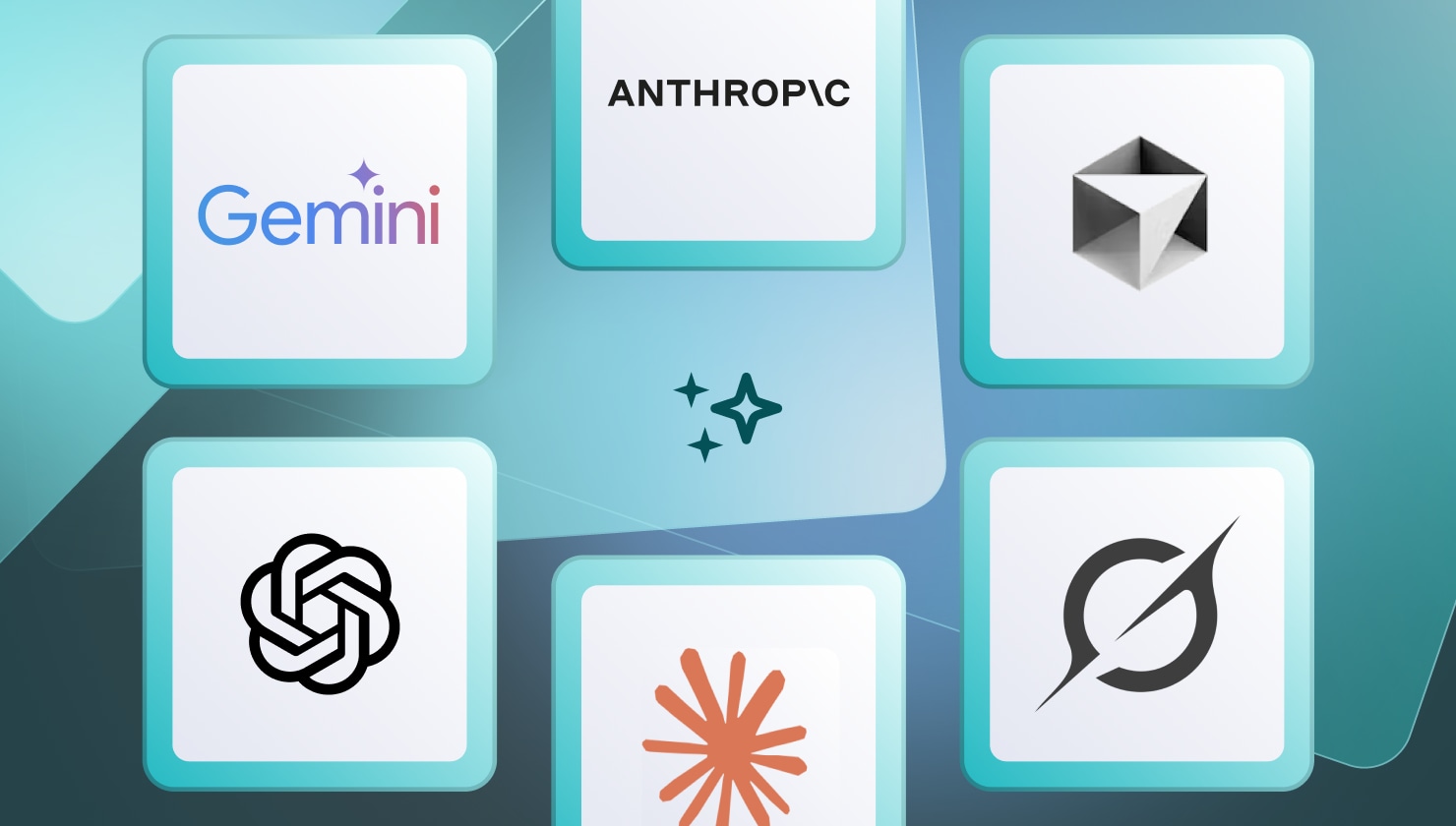
At its simplest, an AI integration connects an AI platform and another app for data transfer and intelligent processing purposes. This makes it an API integration, since AI platforms such as OpenAI GPT-4, Azure OpenAI, xAI Grok, Anthropic Claude, and Google Gemini all have APIs.
Since AI platforms are used to process extensive data and generate intelligent insights, AI integrations often come into play with content creation, data analysis, customer support automation, and decision-making processes. That is, data may be fed from your app to an AI service, which processes it and returns responses, summaries, or generated content that is reintegrated with your workflow.
AI integrations can be either internal to a company or external (intended for a SaaS company's customers).
- Internal integrations – Built for a single company's use and function entirely within that company's ecosystem. An internal AI integration may be built from scratch; that is, it may be custom-coded by company employees or consultants, or it may be built using an enterprise iPaaS (integration platform as a service). In either case, the integration is crafted to address business needs only for that company.
- Customer-facing integrations – Built by employees or consultants of a B2B SaaS company to enable AI-powered data processing between the SaaS company's product and the AI platforms its customers use. Such integrations may be built from scratch, with an enterprise iPaaS, or with an embedded iPaaS. A customer-facing AI integration must usually meet broader requirements than an internal integration because it addresses multiple customers' varied AI workflow needs.
As you can see from the rapidly expanding AI landscape, many AI systems are in the market today. Because of this, B2B SaaS companies often need to build numerous AI integrations for their customers using various AI connectors.
AI agents are changing how B2B SaaS integrations work
AI agents are beginning to use integrations as tools. An agent can retrieve customer data, update a CRM record, or trigger a flow based on a user’s request. Model Context Protocol (MCP) is emerging as a way to expose those tools in a format agents can discover and use.
This differs from adding AI to a SaaS product. An AI-enabled product might summarize records or answer questions in its own interface. Making a product’s integrations available to AI agents exposes its data and actions so agents can use them more broadly. In the first case, AI is a product feature; in the second, integrations become foundations for agent-driven work.
All this makes integration fundamentals more important. Systems must authenticate requests, enforce permissions, validate inputs, and generate clear errors. Deterministic workflows help ensure that an agent’s decisions produce predictable results without unintended side effects.
Top AIs for integrating with B2B SaaS
The AI vertical continues to grow at an incredible rate. Here are a few that are highly ranked (and for which we have connectors).
| Model | Use for B2B SaaS | Considerations | Best fit for |
|---|---|---|---|
| OpenAI | Content generation, chat assistants, code suggestions, document summarization, image creation, and embeddings for semantic search | Broad ecosystem and extensive documentation make it quick to adopt. Usage-based pricing and rate limits scale with volume. Data is processed on OpenAI's infrastructure, which may require extra review for regulated customers. | Teams that want the widest range of model types and the largest developer community |
| Azure OpenAI | The same use cases as OpenAI, deployed for customers in healthcare, finance, government, and other regulated industries | Requires an Azure subscription and model deployments per region. Offers private networking, regional data residency, Microsoft Entra ID authentication, and alignment with compliance frameworks such as SOC 2, HIPAA, and ISO 27001. New models may arrive later than on OpenAI directly. | SaaS vendors selling to enterprises already invested in the Microsoft ecosystem |
| xAI Grok | Trend monitoring, social listening, market intelligence, news-aware chat assistants, and customer engagement tools | Newer platform with a smaller ecosystem and a faster-changing API surface. Its API is largely OpenAI-compatible, which simplifies switching. Evaluate output tone and content moderation needs for customer-facing use. | Products that depend on current events, social sentiment, or up-to-the-minute context |
| Anthropic Claude | Contract and document analysis, research and summarization of large files, agentic workflows with tool use, coding assistance, and customer support automation | Large context windows reduce the need to chunk long documents. Strong tool-use support suits multi-step automations. Available directly or through AWS Bedrock and Google Cloud Vertex AI, which helps meet cloud and data-residency requirements. | Use cases where accuracy, careful reasoning, and predictable behavior matter most |
| Google Gemini | Visual inspection, extracting data from scanned documents and images, video and meeting analysis, and multimodal search | Very large context windows support long documents and media. Tight integration with Google Cloud (Vertex AI) and Google Workspace. Pricing and quotas vary between Google AI Studio and Vertex AI, so choose the access path early. | Products that process mixed media or serve customers built on Google Cloud and Workspace |
Many B2B SaaS teams don't pick just one provider. Supporting multiple AI platforms lets customers bring their preferred model (and their own API keys), lets you route tasks to the best-suited model, and reduces the risk of relying on a single vendor's pricing or availability.
How do you integrate AIs with other apps?
Depending on your business needs, an AI integration can be created in several ways. Let's look at the most common approaches.
Code an AI integration from scratch
Some businesses are choosing to create AI integrations from scratch. They use a dev team that writes custom code for a precise AI integration scenario. This approach is used for both internal and external AI integrations.
However, this approach doesn't scale well for external (customer-facing) integrations. And, it doesn't allow devs who are working on AI functionality to focus on the AI functionality. Instead, they spend their time building out the integration plumbing.
Build an AI integration with an enterprise iPaaS
Other companies use an enterprise iPaaS to build internal AI integrations. Enterprise iPaaS platforms include standard API connectors to AI platforms and related systems, allowing devs to create internal AI integrations more quickly than the old way of coding from scratch. Some companies have even used an enterprise iPaaS to build customer integrations. However, this adds more challenges to the process because iPaaS platforms don't include the functionality (such as an integration marketplace, customer management, and customer dashboards) necessary to support a legitimate customer UX. Enterprise iPaaS systems are not a good fit for creating customer-facing AI integrations.
Build an AI integration with an embedded iPaaS
More and more B2B SaaS companies use embedded iPaaS to create customer-facing AI integrations. These platforms include standard AI connectors to major AI platforms and related systems, streamlining the integration build process. However, unlike enterprise iPaaS, embedded iPaaS is optimized for productizing customer integrations, ensuring that the AI integrations and associated processes will scale with customer growth. Embedded iPaaS includes everything necessary to build, deploy, and support real-world customer AI integrations.
Benefits of creating AI integrations with an embedded iPaaS
An embedded iPaaS provides the greatest benefits when it comes to building AI integrations for your SaaS customers. Let's check out a few of those benefits.
Save engineering time
Building AI integrations for B2B SaaS customers without using the purpose-built functionality of an embedded iPaaS takes much more dev time investment than most companies can afford.
An embedded iPaaS includes a low-code integration designer, a library of built-in AI connectors, an integration marketplace, an embedded workflow builder, integration deployment and support tools, and a cloud-native infrastructure – absolutely everything needed to successfully build, deploy, and support customer AI integrations.
We probably save 95% of [engineering] time. We've deployed far more integrations than we would have without Prismatic.

Increase win rate and sales velocity
An embedded iPaaS allows your team to create reusable, configurable AI integrations in days or weeks instead of months. Doing so lets you say "Yes" more often when an AI integration is part of the functionality your prospects need before they become your customers. Based on a quick dev turnaround, you can frequently include desired AI integrations with initial customer onboarding.
Customers will often want your product to leverage AI capabilities, even if AI isn't your core product focus. Integrating with AI platforms may allow you to offset functional gaps by giving customers intelligent automation and insights they need for their workflows.
Provide a great UX for AI integrations
When you create AI integrations for your customers with an embedded iPaaS, you ensure that those customers will have a first-class AI integration experience. Such integrations become obvious (and essential) product functionality.
Further, your customers won't suffer from the classic black-box integration experience, where they rely entirely on your support and dev teams to tell them what is happening with their integrations. Instead, customers can enable, configure, and even support their AI integrations because they have access to config, status, log, and alerting data.
Change is a constant in the rapidly evolving AI landscape, and an embedded iPaaS makes it easy to update and enhance AI integrations while simultaneously managing and versioning the underlying code within your standard CI/CD processes.
Improve your customer service
When you use an embedded iPaaS for AI integration, your integrations run on a purpose-built infrastructure with built-in compliance, scalability, and security. This greatly reduces performance issues and other problems with AI integrations.
Since no time is spent on infrastructure issues, support can focus on the AI integrations themselves. This is where the deployment and support tools built into the embedded iPaaS come into play. With those tools, your non-devs can do much of the support that devs have traditionally handled.
You can also set up your customers to self-service their AI integrations, allowing them to manage auth, view logs, set config, monitor statuses, and otherwise directly interact with their AI integrations without relying on your support teams for first-level support.
[Our customers] are happy. They feel in control. They feel empowered. And [Prismatic] opens up even more opportunities that our customers haven't even thought about. They came in wanting integration X and they see it there and they're like, oh, look, it's integration Y and Z. Let's also enable those.

Reduce customer churn
Using an embedded integration platform for your customers' AI integrations can help reduce customer churn by making your product essential to your customers because it's connected to their critical AI workflows. The platform can elevate embedded AI integrations in visibility and value, establishing them as key product differentiators.
For customers, leaving your product with its AI integrations means removing your app and losing essential AI-powered automation and insights. Finding another vendor to replace your app and its AI integrations drives up the cost of switching, reducing churn risk.
Advanced AI integration scenarios
AI integrations often require sophisticated workflows, and falling behind on these capabilities could mean losing ground to competitors:
- Multi-model orchestration – Using different AI models for different tasks (for example, GPT-4 for text, Gemini for images)
- Real-time processing – Streaming responses from AI platforms for interactive applications
- Context management – Maintaining conversation context across multiple AI interactions
- Token optimization – Managing costs by optimizing prompt engineering and response processing
- Multimodal processing – Handling text, images, audio, and other data types in unified workflows
Security and compliance considerations
AI integrations also require special attention to security and compliance:
- Data privacy – Ensuring sensitive data is handled appropriately when sent to AI platforms
- Content filtering – Implementing appropriate safeguards for AI-generated content
- Audit trails – Maintaining detailed logs of AI processing for compliance requirements
- Access controls – Managing who can configure and use AI integrations
- Cost controls – Implementing usage limits and monitoring to prevent unexpected charges
Keep the data flowing
No matter which AI integrations you need to build for your SaaS product's customers, an embedded iPaaS allows you to build, deploy, and support those integrations as first-class product features. With built-in AI connectors for all major platforms and the flexibility to handle complex AI workflows, Prismatic helps you provide the intelligent capabilities your customers expect.
The AI landscape continues to evolve rapidly, with new models, capabilities, and platforms emerging regularly. An embedded iPaaS ensures you can adapt to these changes quickly, adding new AI integrations and updating existing ones without starting from scratch every time.
Schedule a demo and let us show you how Prismatic supports powerful, reusable, configurable AI integrations between your SaaS product and your customers' preferred AI platforms.