Build vs Buy
"Why do I need an iPaaS? I can build this all myself."
- Every engineer ever
The challenge isn't building integrations - it's building the infrastructure that makes them reliable, secure, and maintainable at scale. This is deceptively difficult engineering that looks simple until you encounter the edge cases.
Your customers don't care if you built webhook or OAuth 2.0 infrastructure yourself, or leaned on an iPaaS. They care that their data syncs reliably and that your product solves their problems.
The easy part
When you first think about building integrations, you focus on getting information from point A to point B. That part of the problem is generally straight-forward. Figure out how authentication works with a third-party app, examine their API docs, and then make the calls you need to fetch or push data. Your team can knock out the basic data flow in a few days.
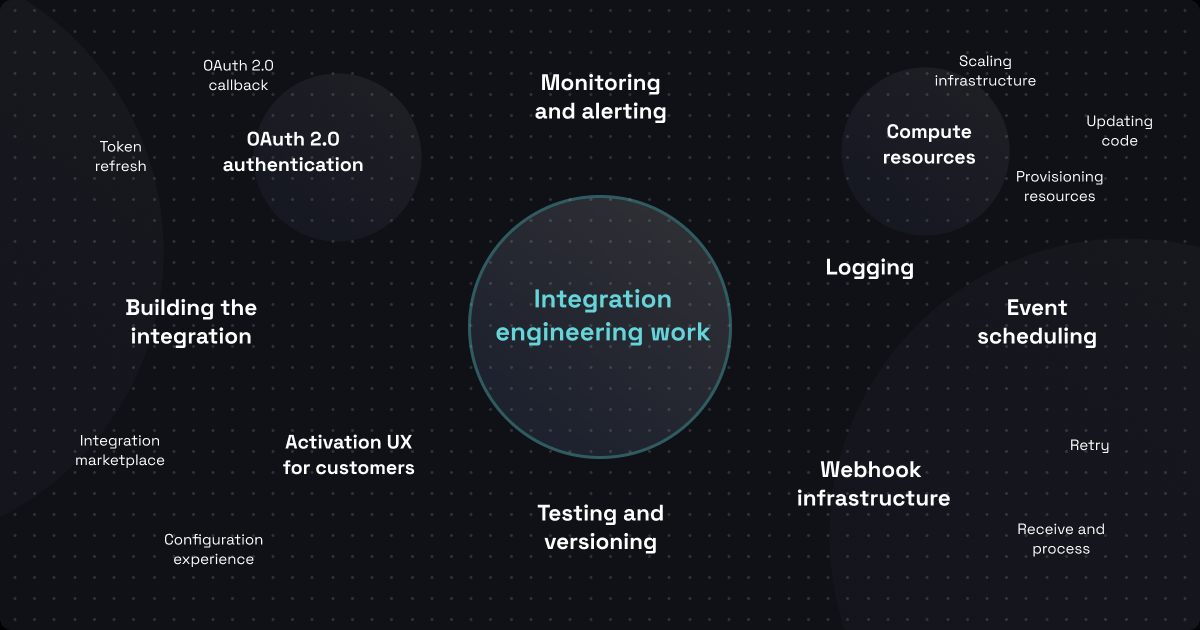
The problem is that getting a basic integration working is only the beginning. The hard part is handling everything that happens after "it works on my machine." Once you have some code that pulls data from one API, transforms it, and sends it to another API, you start the "long tail" of the integration development process.
The hard part
Multi-tenant isolation at scale
Your integration platform needs to run code from different customers in isolation while efficiently sharing resources. Getting this wrong means one customer's runaway integration affects others, or worse, customer A can access customer B's data. Proper isolation requires deep expertise in container orchestration, resource limits, and security boundaries. This isn't just about spinning up containers - it's about preventing resource exhaustion, quota management, and ensuring security boundaries hold under load.
OAuth that actually works
OAuth 2.0 seems simple until you implement it. Different providers interpret the spec differently. Some use JWT tokens, others use opaque tokens. Refresh token rotation, PKCE flows, state parameter validation, and handling clock skew all have subtle failure modes. Miss any of these details and you'll leak credentials or fail intermittently in ways that are difficult to debug. You'll discover these edge cases only after customers report mysterious auth failures.
Idempotency and retry logic
What happens when an API is down? Or rate limited? You need queue management, exponential backoff, replay logic, and a way to notify customers when something fails. Multiply this across dozens of third-party APIs.
Monitoring and observability
You need logging, alerting, and dashboards to diagnose issues before customers report them. Integration problems are rarely obvious - was it bad data, an API change, a network issue, or a bug in your code?
Webhook reliability
Receiving webhooks reliably requires handling duplicate deliveries, validating signatures (each vendor does this differently), managing replay attacks, queue overflow, and poison messages. What happens when your webhook handler has a bug? You need to replay millions of events without duplicates or missing data. This is a surprisingly deep distributed systems problem that looks simple until you need to handle it at scale.
Credential encryption at rest and in transit
Your integration platform stores API keys and OAuth tokens for every customer. A breach here exposes all your customers' third-party systems. Proper credential management requires envelope encryption, key rotation, audit logging, and defense-in-depth security. Half-measures create vulnerabilities that you won't discover until it's too late. This requires dedicated security expertise and constant vigilance.
Customer self-service
You want your customers to configure integrations for themselves. That means coordination between your frontend and backend teams, as your frontend team crafts a pleasant experience for your users and the backend team spins up new databases that can safely house the configuration.
The real question
Can you build an integration platform? Yes. Can you build one that handles edge cases correctly, scales reliably, maintains security, and doesn't become a maintenance nightmare? That's substantially harder.
The challenge isn't writing integration code - it's building infrastructure that your team can confidently deploy and maintain without becoming experts in distributed systems, security, OAuth minutiae, and the quirks of dozens of third-party APIs.
Integration infrastructure is complex, specialized work. The question isn't whether you have the capability to build it, but whether building this infrastructure is where your engineering expertise will have the most impact.