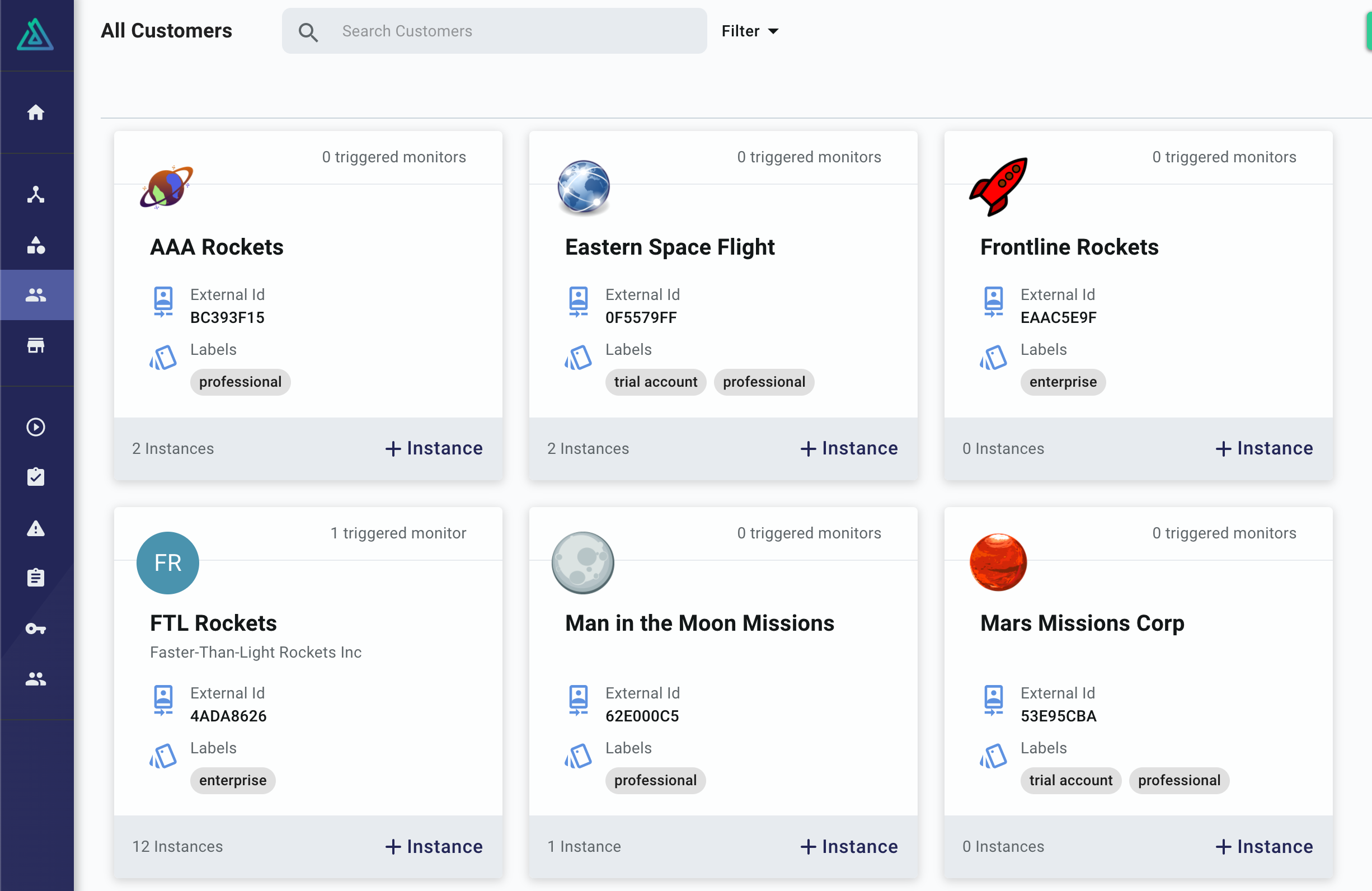
Labels for Customers, Integrations and Instances
You can now assign labels to your customers, integrations and instances. This helps you keep your Prismatic account organized so you can find what you need quickly.
Changelog
Stay up to date with the latest changes and improvements to our product.
You can now assign labels to your customers, integrations and instances. This helps you keep your Prismatic account organized so you can find what you need quickly.
You can now create custom themes for your embedded marketplace for both dark and light mode users of your application. Check out our embedded marketplace docs for information on how to theme your embedded marketplace to match your app's dark and light mode look-and-feel.
We have a couple new components this month! A full catalog is available here. This past month, we added:
We have some new components to show off this month:
It's now easier to integrate with SOAP-based APIs. For quick one-off calls, you can use our built-in SOAP component to fetch WSDL definitions and make requests to an API's SOAP methods. For more complex SOAP APIs, you can leverage our custom component SDK to wrap SOAP methods into a series of component actions.
We've revamped the way that components connect to third-party apps and services. The new concept is called connections, and they make authentication simpler, more flexible, and easier to support.
We'll be updating our built-in components to use connections in the coming weeks, and credentials will eventually be phased out in favor of connections (but don't worry - credentials won't be sunset immediately!).
For a full run-down how connections improve integration development and support and customer self-deployment, check out our blog announcement. Here's a quick summary:
We created new components for three popular SaaS apps this month:
A full catalog of all of our components is available here.
The loop component has been improved to facilitate easily looping over a paginated API. Many third-party APIs limit the number of records you can fetch at once, and let you load a batch (page) of records at a time. You can now more easily loop over paged records that you fetch from an external API, and you can break out of a loop whenever you've paged over all available records.
Check out our quickstart for a tutorial on how to loop over pages of records in an integration.
We have a bunch of new built-in components this month. A full catalog is available here. This past month, we added:
Customers on enterprise plans can now stream logs and metrics to external logging services (like DataDog or New Relic). This is useful, since you likely already use a logging service to collect logs from your various applications. Now, your integration logs can live alongside the rest of your applications' logs.
Read more on our logging article.