<?xml version="1.0" encoding="utf-8"?>
<feed xmlns="http://www.w3.org/2005/Atom">
    <id>https://prismatic.io/docs/changelog/</id>
    <title>Prismatic Changelog</title>
    <updated>2026-09-30T00:00:00.000Z</updated>
    <generator>https://github.com/jpmonette/feed</generator>
    <link rel="alternate" href="https://prismatic.io/docs/changelog/"/>
    <subtitle>Prismatic Docs Blog</subtitle>
    <icon>https://prismatic.io/docs/img/favicon.svg</icon>
    <entry>
        <title type="html"><![CDATA[New Executions Experience]]></title>
        <id>https://prismatic.io/docs/changelog/2026/09/30/new-executions-experience/</id>
        <link href="https://prismatic.io/docs/changelog/2026/09/30/new-executions-experience/"/>
        <updated>2026-09-30T00:00:00.000Z</updated>
        <summary type="html"><![CDATA[Executions are now split into two dedicated views to make troubleshooting faster:]]></summary>
        <content type="html"><![CDATA[<p>Executions are now split into two dedicated views to make troubleshooting faster:</p>
<ul>
<li class=""><strong>List view</strong>: Filter executions by trigger payload data with AND/OR conditions, select custom date ranges within the 14-day retention window, and replay failed executions in bulk.</li>
<li class=""><strong>Detail view</strong>: See a plain-language error message, a step-by-step timeline, and step logs, outputs, and the trigger payload in one place.</li>
</ul>
<p>Log search now covers the full 14-day retention window (previously 48 hours), and the default search window is now 24 hours.</p>
<p>Code-native integrations can use <code>logger.section()</code> and <code>logger.sectionEnd()</code> to split <code>onExecution</code> logic into named sections, each with its own status, timing, and logs in the detail view.
Execution sections require the latest version of <code>@prismatic-io/spectral</code>.</p>]]></content>
        <category label="Observability" term="Observability"/>
        <category label="Code-Native" term="Code-Native"/>
    </entry>
    <entry>
        <title type="html"><![CDATA[Concurrent Editing Notifications]]></title>
        <id>https://prismatic.io/docs/changelog/2026/09/23/concurrent-editing-notifications/</id>
        <link href="https://prismatic.io/docs/changelog/2026/09/23/concurrent-editing-notifications/"/>
        <updated>2026-09-23T00:00:00.000Z</updated>
        <summary type="html"><![CDATA[The Embedded Workflow Builder and low-code designer now warn you when someone else saves a newer version while you're editing.]]></summary>
        <content type="html"><![CDATA[<p>The Embedded Workflow Builder and low-code designer now warn you when someone else saves a newer version while you're editing.
You'll see a banner with the option to reload to see the saved changes, overwrite the draft anyway, or copy the workflow.
The same protection applies across multiple tabs and to Copilot.</p>]]></content>
        <category label="Low-Code" term="Low-Code"/>
        <category label="Workflow Builder" term="Workflow Builder"/>
    </entry>
    <entry>
        <title type="html"><![CDATA[Opening User Level Config Directly]]></title>
        <id>https://prismatic.io/docs/changelog/2026/09/08/opening-user-level-config-directly/</id>
        <link href="https://prismatic.io/docs/changelog/2026/09/08/opening-user-level-config-directly/"/>
        <updated>2026-09-08T00:00:00.000Z</updated>
        <summary type="html"><![CDATA[If you embed Prismatic in your own application, the embedded SDK adds editUserLevelConfiguration(), which renders a customer user's own configuration inline so they can connect their own account without being taken through the instance's configuration.]]></summary>
        <content type="html"><![CDATA[<p>If you embed Prismatic in your own application, the embedded SDK adds <code>editUserLevelConfiguration()</code>, which renders a customer user's own configuration inline so they can connect their own account without being taken through the instance's configuration.
This function requires <code>@prismatic-io/embedded</code> version <code>4.14.0</code> or later.
See <a class="" href="https://prismatic.io/docs/embed/marketplace/#open-a-customer-users-own-configuration">opening a customer user's own configuration</a> for implementation details.</p>]]></content>
        <category label="Embedded" term="Embedded"/>
        <category label="Connections" term="Connections"/>
    </entry>
    <entry>
        <title type="html"><![CDATA[Reusable User Connections]]></title>
        <id>https://prismatic.io/docs/changelog/2026/09/08/reusable-user-connections/</id>
        <link href="https://prismatic.io/docs/changelog/2026/09/08/reusable-user-connections/"/>
        <updated>2026-09-08T00:00:00.000Z</updated>
        <summary type="html"><![CDATA[You can now create reusable connections that are scoped to individual users, so your customers' users can connect their own accounts to third-party apps and services without needing to share credentials.]]></summary>
        <content type="html"><![CDATA[<p>You can now create reusable connections that are scoped to individual users, so your customers' users can connect their own accounts to third-party apps and services without needing to share credentials.</p>
<p>This brings together two existing concepts: <a class="" href="https://prismatic.io/docs/integrations/config-wizard/user-level-configuration/">User-Level Config</a> and reusable <a class="" href="https://prismatic.io/docs/integrations/connections/">Connections</a>.
User-level connections can now be defined outside of the scope of an integration.</p>
<p>Read more about <a class="" href="https://prismatic.io/docs/integrations/connections/integration-agnostic-connections/user/">user connections</a> and how to use them in your code-native and low-code integrations.</p>]]></content>
        <category label="Connections" term="Connections"/>
    </entry>
    <entry>
        <title type="html"><![CDATA[Embedded Workflow Builder Copilot Improvements]]></title>
        <id>https://prismatic.io/docs/changelog/2026/08/20/embedded-workflow-builder-copilot-improvements/</id>
        <link href="https://prismatic.io/docs/changelog/2026/08/20/embedded-workflow-builder-copilot-improvements/"/>
        <updated>2026-08-20T00:00:00.000Z</updated>
        <summary type="html"><![CDATA[The copilot in the embedded workflow builder has been re-architected from the ground up:]]></summary>
        <content type="html"><![CDATA[<p>The copilot in the embedded workflow builder has been re-architected from the ground up:</p>
<ul>
<li class=""><strong>Faster builds</strong>: The copilot now handles many build actions at once instead of one at a time, so workflows come together with fewer round trips.</li>
<li class=""><strong>More reliable results.</strong> Purpose-built agents handle research, planning, building, and testing behind the scenes for more predictable behavior.</li>
<li class=""><strong>Context about your product.</strong> You can now give the copilot context about your product and API through the SDK, so your users get workflows built for your platform, not generic ones.
Read about <a class="" href="https://prismatic.io/docs/embed/workflow-builder/ai-copilot-context/">providing context to the copilot</a> for details.</li>
</ul>
<p>Nothing changes on your end. The upgrade applies automatically, the canvas stays the source of truth, and everything your users build today carries forward.</p>]]></content>
        <category label="AI" term="AI"/>
        <category label="Workflow Builder" term="Workflow Builder"/>
    </entry>
    <entry>
        <title type="html"><![CDATA[Large data syncs in the low-code designer and embedded workflow builder]]></title>
        <id>https://prismatic.io/docs/changelog/2026/08/19/large-data-syncs-in-the-low-code-designer-and-embedded-workflow-builder/</id>
        <link href="https://prismatic.io/docs/changelog/2026/08/19/large-data-syncs-in-the-low-code-designer-and-embedded-workflow-builder/"/>
        <updated>2026-08-19T00:00:00.000Z</updated>
        <summary type="html"><![CDATA[Enable batching in the flow control tab(maxWidth left)]]></summary>
        <content type="html"><![CDATA[<p><span class="wrapper_oYSK floatLeft_riT1"><style data-emotion="css 1wz7j1i">.css-1wz7j1i{background-color:#0000}@media print{.css-1wz7j1i{position:absolute!important}}</style><span style="display:inline-block;margin:0;max-width:220px"><img decoding="async" loading="lazy" alt="Enable batching in the flow control tab" src="https://prismatic.io/docs/assets/images/large-data-sync-low-code-85b1b6f1798135994384ed3eb8e5acb4.png" width="709" height="914" class="img_CujE"></span></span></p>
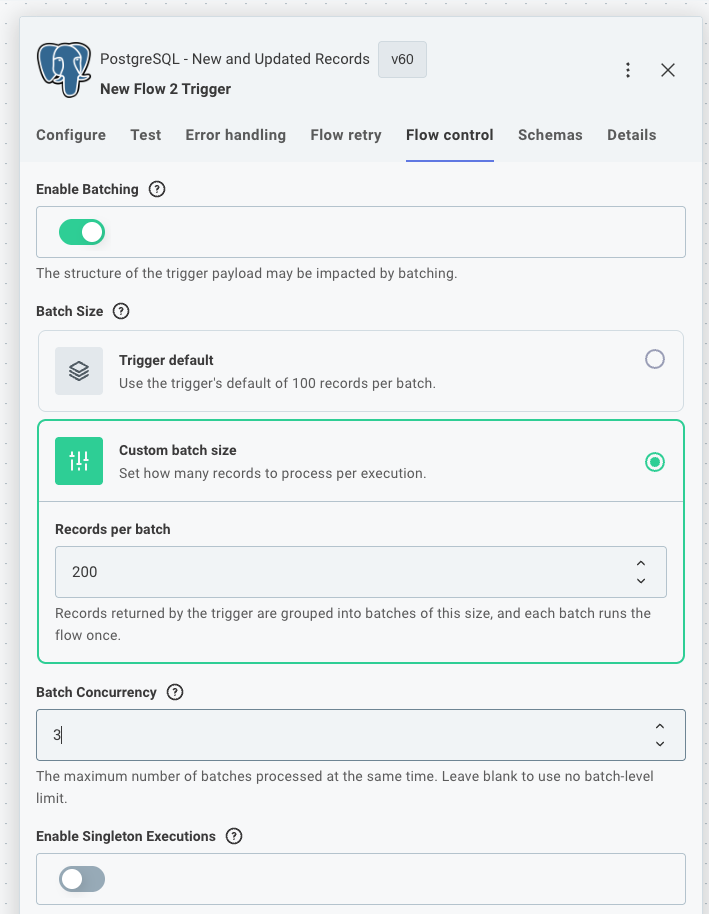
<p>Custom connector triggers can now split the records they fetch into batches, so a flow in the low-code designer or embedded workflow builder can sync large datasets without one long-running execution doing all the work.
This brings the code-native <a class="" href="https://prismatic.io/docs/integrations/common-patterns/large-data-sync/"><code>batchFlowTrigger</code></a> pattern to low-code flows and embedded workflows.</p>
<p>This is useful when polling for new records from a third-party API, or when efficiently backfilling existing records on instance deployment.</p>
<p>See <a class="" href="https://prismatic.io/docs/custom-connectors/triggers/#large-data-syncs">large data syncs in custom triggers</a> for usage and code examples.</p>
<p>We've updated polling triggers in our <a class="" href="https://prismatic.io/docs/components/salesforce/">Salesforce</a>, <a class="" href="https://prismatic.io/docs/components/hubspot/">HubSpot</a>, and <a class="" href="https://prismatic.io/docs/components/postgres/">PostgreSQL</a> connectors to use this new pattern, with more to come!</p>]]></content>
        <category label="Low-Code" term="Low-Code"/>
        <category label="Workflow Builder" term="Workflow Builder"/>
        <category label="Custom Connectors" term="Custom Connectors"/>
        <category label="Runner" term="Runner"/>
    </entry>
    <entry>
        <title type="html"><![CDATA[Improved step outputs and references in EWB and low-code]]></title>
        <id>https://prismatic.io/docs/changelog/2026/08/04/improved-step-outputs-and-references-in-ewb-and-low-code/</id>
        <link href="https://prismatic.io/docs/changelog/2026/08/04/improved-step-outputs-and-references-in-ewb-and-low-code/"/>
        <updated>2026-08-04T00:00:00.000Z</updated>
        <summary type="html"><![CDATA[When you reference a previous step in the Embedded Workflow Builder or low-code designer, you can now see the real data that step would return, without running a test of your whole workflow.]]></summary>
        <content type="html"><![CDATA[<p>When you reference a previous step in the Embedded Workflow Builder or low-code designer, you can now see the real data that step would return, without running a test of your whole workflow.
The reference panel has also been redesigned so the payload data you reference most is front and center, with less common properties tucked out of the way.</p>
<p>Update your custom connectors to take advantage of new step output options - read more at <a class="" href="https://prismatic.io/docs/custom-connectors/step-outputs/">Step Outputs</a>.</p>]]></content>
        <category label="Workflow Builder" term="Workflow Builder"/>
        <category label="Low-Code" term="Low-Code"/>
        <category label="Custom Connectors" term="Custom Connectors"/>
    </entry>
    <entry>
        <title type="html"><![CDATA[Authentication profiles for the prism CLI]]></title>
        <id>https://prismatic.io/docs/changelog/2026/07/22/authentication-profiles-for-the-prism-cli/</id>
        <link href="https://prismatic.io/docs/changelog/2026/07/22/authentication-profiles-for-the-prism-cli/"/>
        <updated>2026-07-22T00:00:00.000Z</updated>
        <summary type="html"><![CDATA[The prism CLI now supports authentication profiles, so you can stay logged in to multiple Prismatic stacks or tenants at once.]]></summary>
        <content type="html"><![CDATA[<p>The <code>prism</code> CLI now supports authentication profiles, so you can stay logged in to multiple Prismatic stacks or tenants at once.
Each profile stores its own endpoint, tenant, and credentials, which makes switching between regions much simpler than juggling <code>PRISMATIC_URL</code> environment variables.</p>
<p>Create a named profile with <code>prism login --profile &lt;name&gt;</code>, then select it per command with the <code>--profile</code> flag, for a shell session with <code>PRISM_PROFILE</code>, or as your default with <code>prism profiles:use &lt;name&gt;</code>.
Run <code>prism profiles:list</code> to view saved profiles and <code>prism profiles:delete &lt;name&gt;</code> to remove one.</p>
<p>See <a class="" href="https://prismatic.io/docs/cli/#authentication-profiles">authenticating with the CLI tool</a> for details.</p>]]></content>
        <category label="Dev Tools" term="Dev Tools"/>
    </entry>
    <entry>
        <title type="html"><![CDATA[Upgraded charts for at-a-glance integration health]]></title>
        <id>https://prismatic.io/docs/changelog/2026/07/06/upgraded-charts-for-at-a-glance-integration-health/</id>
        <link href="https://prismatic.io/docs/changelog/2026/07/06/upgraded-charts-for-at-a-glance-integration-health/"/>
        <updated>2026-07-06T00:00:00.000Z</updated>
        <summary type="html"><![CDATA[We've rebuilt the charts across Prismatic.]]></summary>
        <content type="html"><![CDATA[<p>We've rebuilt the charts across Prismatic.
New interactive charts now appear on the Home page, integration landing pages, and your Customer, Instance, and Org Utilization views, so you can spot trends and jump straight to the executions behind any spike.</p>
<p>Toggle any chart between bar and line, and click into a day on the Executions Success/Failure chart to drill through to the underlying execution.
Where available, you'll see up to 14 days of history.</p>]]></content>
        <category label="Observability" term="Observability"/>
    </entry>
    <entry>
        <title type="html"><![CDATA[New default toolchain for components and code-native integrations]]></title>
        <id>https://prismatic.io/docs/changelog/2026/07/01/new-default-toolchain-for-components-and-code-native-integrations/</id>
        <link href="https://prismatic.io/docs/changelog/2026/07/01/new-default-toolchain-for-components-and-code-native-integrations/"/>
        <updated>2026-07-01T00:00:00.000Z</updated>
        <summary type="html"><![CDATA[prism componentsinit now scaffold new projects with a new, modern toolchain for building, testing, linting, and formatting your code.]]></summary>
        <content type="html"><![CDATA[<p><code>prism components:init</code> and <code>prism integrations:init</code> now scaffold new projects with a new, modern toolchain for building, testing, linting, and formatting your code.</p>
<p>If you run into issues with the modern toolchain, you can scaffold with the previous toolchain by passing <code>--toolchain legacy</code> - and please <a href="mailto:support@prismatic.io" target="_blank" rel="noopener noreferrer" class="">contact support</a> so we can address it.</p>
<p>This change ships in a new major version of the <code>prism</code> CLI.</p>
<p>Want to update an existing code-native integration or custom connector to use our new recommended toolchain? See the <a class="" href="https://prismatic.io/docs/spectral/spectral-10-22-upgrade-guide/">Spectral 10.22 Upgrade Guide</a> for instructions.</p>]]></content>
        <category label="Custom Connectors" term="Custom Connectors"/>
        <category label="Code-Native" term="Code-Native"/>
        <category label="Dev Tools" term="Dev Tools"/>
    </entry>
    <entry>
        <title type="html"><![CDATA[Large data sync with batchFlowTrigger]]></title>
        <id>https://prismatic.io/docs/changelog/2026/06/24/large-data-sync-with-batchflowtrigger/</id>
        <link href="https://prismatic.io/docs/changelog/2026/06/24/large-data-sync-with-batchflowtrigger/"/>
        <updated>2026-06-24T00:00:00.000Z</updated>
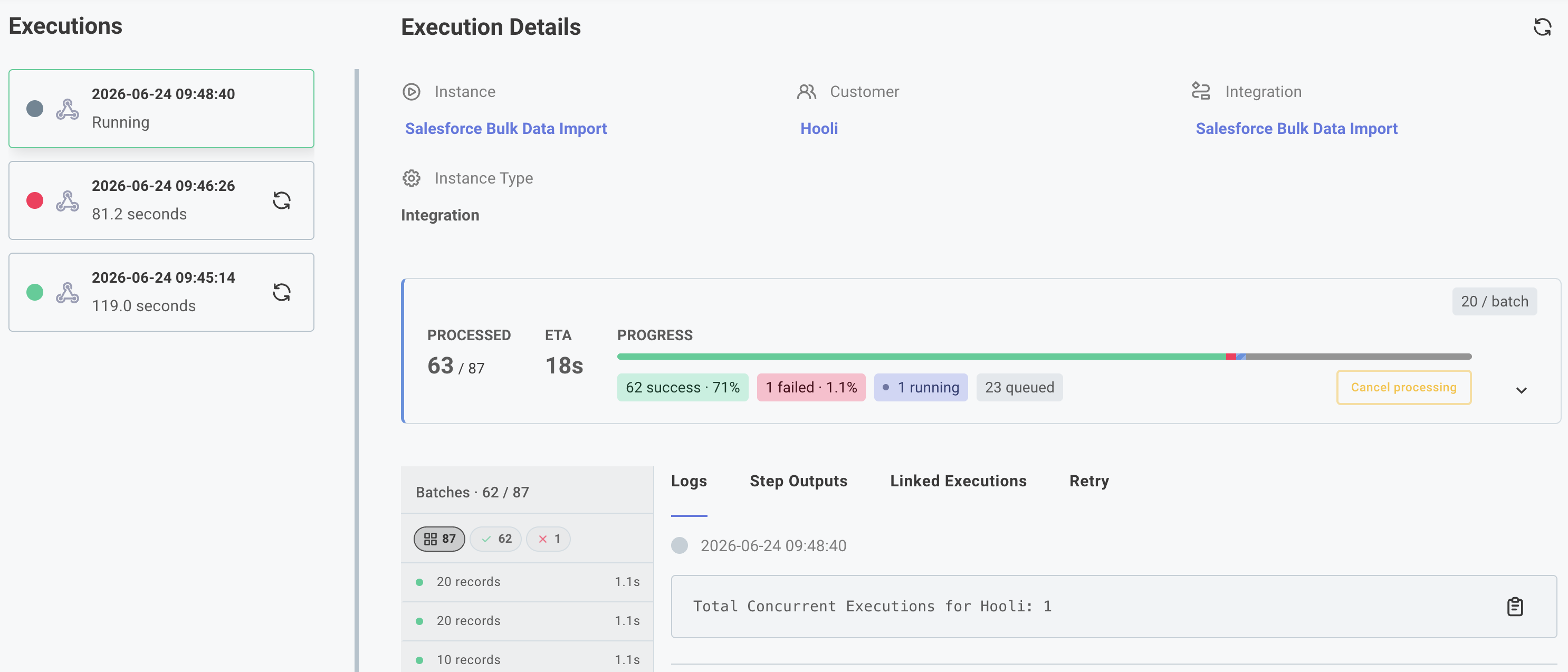
        <summary type="html"><![CDATA[Code-native integrations can now use batchFlowTrigger to backfill large datasets on deploy and process real-time events through the same execution path - no manual recursion required.]]></summary>
        <content type="html"><![CDATA[<p>Code-native integrations can now use <code>batchFlowTrigger</code> to backfill large datasets on deploy and process real-time events through the same execution path - no manual recursion required.</p>
<p>Define an <code>onDeploy</code> function to page through your source API on instance deployment, returning a <code>paginationState</code> cursor so each invocation picks up where the last one left off.
Define an <code>onTrigger</code> function to handle incoming webhooks after the initial sync completes.
Both funnel records into a single <code>onExecution</code> function, and <code>batchConfig</code> controls how many records arrive per call and how many batches run concurrently.</p>
<p><span class="wrapper_oYSK"><style data-emotion="css 1wz7j1i">.css-1wz7j1i{background-color:#0000}@media print{.css-1wz7j1i{position:absolute!important}}</style><span style="display:inline-block;margin:0;max-width:800px"><img decoding="async" loading="lazy" alt="Large data sync execution results" src="https://prismatic.io/docs/assets/images/large-data-sync-execution-results-31977ac3a25800a959b219f73aaa90db.png" width="2972" height="1274" class="img_CujE"></span></span></p>
<p>See <a class="" href="https://prismatic.io/docs/integrations/common-patterns/large-data-sync/">Large Data Sync</a> for usage and examples and <a class="" href="https://prismatic.io/docs/get-started/build-integrations/large-data-syncs/">here</a> for a video walkthrough.</p>]]></content>
        <category label="Code-Native" term="Code-Native"/>
        <category label="Runner" term="Runner"/>
    </entry>
    <entry>
        <title type="html"><![CDATA[Structured and dynamic object inputs for custom connectors]]></title>
        <id>https://prismatic.io/docs/changelog/2026/06/22/structured-and-dynamic-object-inputs-for-custom-connectors/</id>
        <link href="https://prismatic.io/docs/changelog/2026/06/22/structured-and-dynamic-object-inputs-for-custom-connectors/"/>
        <updated>2026-06-22T00:00:00.000Z</updated>
        <summary type="html"><![CDATA[Custom connector actions now support two new input types that let you represent complex data directly on the canvas - no code step required.]]></summary>
        <content type="html"><![CDATA[<p>Custom connector actions now support two new input types that let you represent complex data directly on the canvas - no code step required.</p>
<p><strong>Structured object inputs</strong> group related sub-inputs into a single named object.
For example, a "Mailing Address" input can expose individual <code>street</code>, <code>city</code>, <code>state</code>, and <code>zip</code> fields rather than forcing builders to construct the object manually.
In your action's <code>perform</code> function, the value is a plain object accessible by field name (e.g. <code>inputs.address.city</code>).</p>
<p><strong>Dynamic object inputs</strong> show a different set of sub-inputs depending on which record type or configuration the builder selects.
For example, a "Create Record" action can present Account, Lead, or Contact input fields based on the builder's choice, with <code>inputs.record.configuration</code> identifying the selection and <code>inputs.record.values</code> holding the corresponding field values.</p>
<p>See <a class="" href="https://prismatic.io/docs/custom-connectors/inputs/#structured-object-inputs">structured object inputs</a> and <a class="" href="https://prismatic.io/docs/custom-connectors/inputs/#dynamic-object-inputs">dynamic object inputs</a> for usage and code examples.</p>]]></content>
        <category label="Custom Connectors" term="Custom Connectors"/>
    </entry>
    <entry>
        <title type="html"><![CDATA[Open Source Public Components]]></title>
        <id>https://prismatic.io/docs/changelog/2026/06/04/open-source-public-components/</id>
        <link href="https://prismatic.io/docs/changelog/2026/06/04/open-source-public-components/"/>
        <updated>2026-06-04T00:00:00.000Z</updated>
        <summary type="html"><![CDATA[The source for Prismatic-built components is now on GitHub.]]></summary>
        <content type="html"><![CDATA[<p>The source for Prismatic-built components is now on GitHub.
When one of our components is close but not quite what your customers need, you no longer have to rebuild from scratch.
Fork it, add the behavior you want, and publish it as your own private component.
You can also use our components as a reference for building net-new ones, or just read the source to see exactly how something works.</p>
<div style="margin:0 auto 1em auto"><div style="padding-top:calc(100% * 9 / 16);position:relative"><iframe src="https://player.vimeo.com/video/1202568780" style="position:absolute;top:0;left:0;width:100%;height:100%" allowfullscreen="" data-ready="true"></iframe></div></div>
<p>Check it out in <a href="https://github.com/prismatic-io/components" target="_blank" rel="noopener noreferrer" class="">GitHub</a>.</p>]]></content>
        <category label="Connectors" term="Connectors"/>
        <category label="Custom Connectors" term="Custom Connectors"/>
    </entry>
    <entry>
        <title type="html"><![CDATA[Connection management has been streamlined]]></title>
        <id>https://prismatic.io/docs/changelog/2026/05/11/connection-management-has-been-streamlined/</id>
        <link href="https://prismatic.io/docs/changelog/2026/05/11/connection-management-has-been-streamlined/"/>
        <updated>2026-05-11T00:00:00.000Z</updated>
        <summary type="html"><![CDATA[New connections experience in the Components section(maxWidth left)]]></summary>
        <content type="html"><![CDATA[<p><span class="wrapper_oYSK floatLeft_riT1"><style data-emotion="css 1wz7j1i">.css-1wz7j1i{background-color:#0000}@media print{.css-1wz7j1i{position:absolute!important}}</style><span style="display:inline-block;margin:0;max-width:300px"><img decoding="async" loading="lazy" alt="New connections experience in the Components section" src="https://prismatic.io/docs/assets/images/new-reusable-connection-ui-c64f82f204306b7822837995a34a834c.png" width="1262" height="1252" class="img_CujE"></span></span></p>
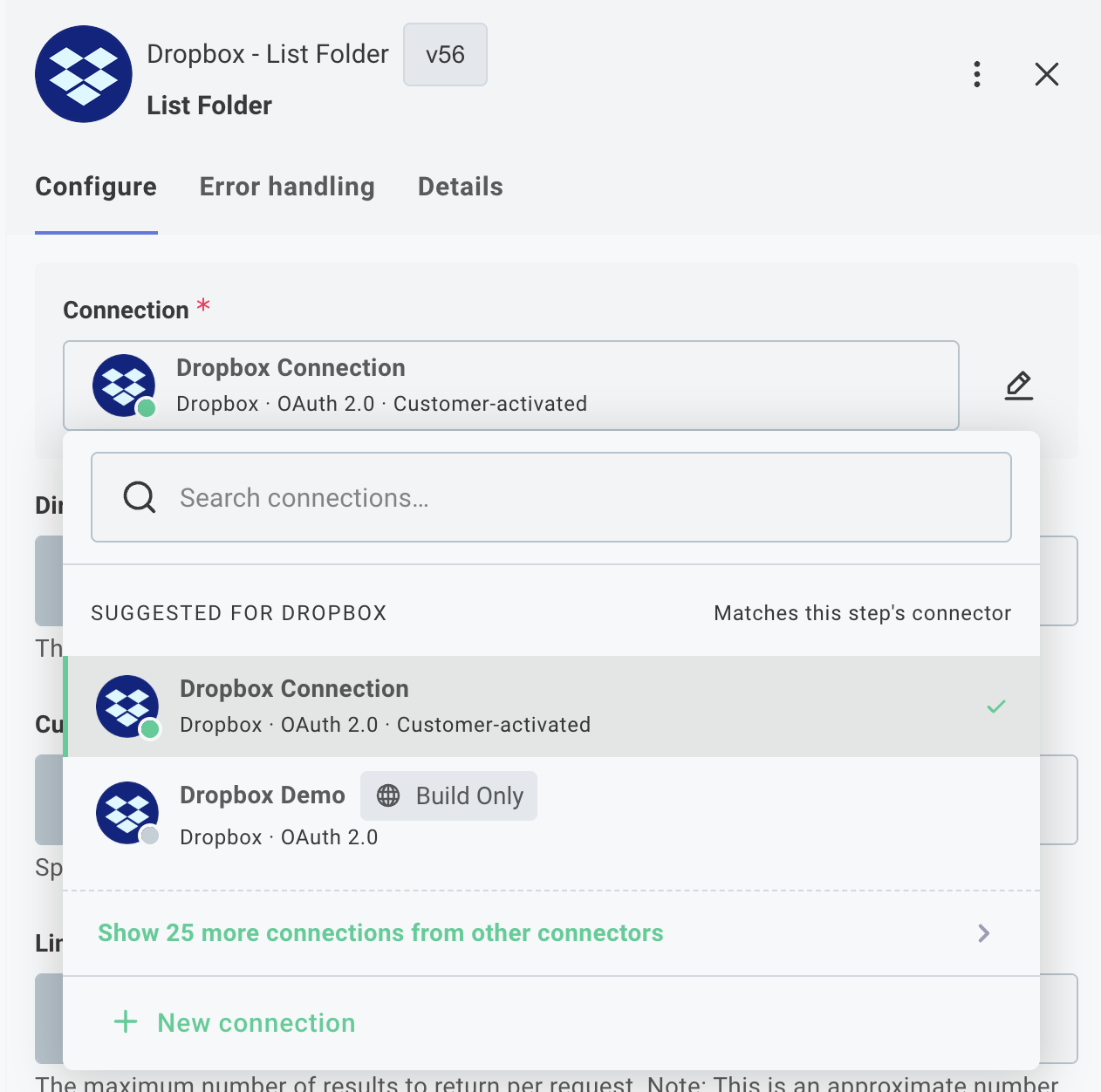
<p>We've refreshed how connections are set up and managed to make reusable connections a first-class part of building an integration.</p>
<p>A few things to know about the new experience:</p>
<ul>
<li class="">Reusable connections are now created and managed from the <strong>Components</strong> section.
Search for a component, open its <strong>Connections</strong> tab, and click <strong>+ Add Connection</strong>.</li>
<li class="">You can also create reusable connections directly from the canvas - when picking a trigger, adding a step, or from a step's connection input field.</li>
<li class="">A pencil icon next to a step's connection lets you edit it without leaving the canvas.</li>
</ul>
<p>Existing connections, integrations, and instances continue to work without changes.</p>]]></content>
        <category label="Connections" term="Connections"/>
    </entry>
    <entry>
        <title type="html"><![CDATA[AI Copilot for Embedded Workflow Builder General Availability]]></title>
        <id>https://prismatic.io/docs/changelog/2026/04/16/ai-copilot-for-embedded-workflow-builder-general-availability/</id>
        <link href="https://prismatic.io/docs/changelog/2026/04/16/ai-copilot-for-embedded-workflow-builder-general-availability/"/>
        <updated>2026-04-16T00:00:00.000Z</updated>
        <summary type="html"><![CDATA[The AI copilot for the embedded workflow builder is now generally available to all customers who have embedded workflow builder enabled.]]></summary>
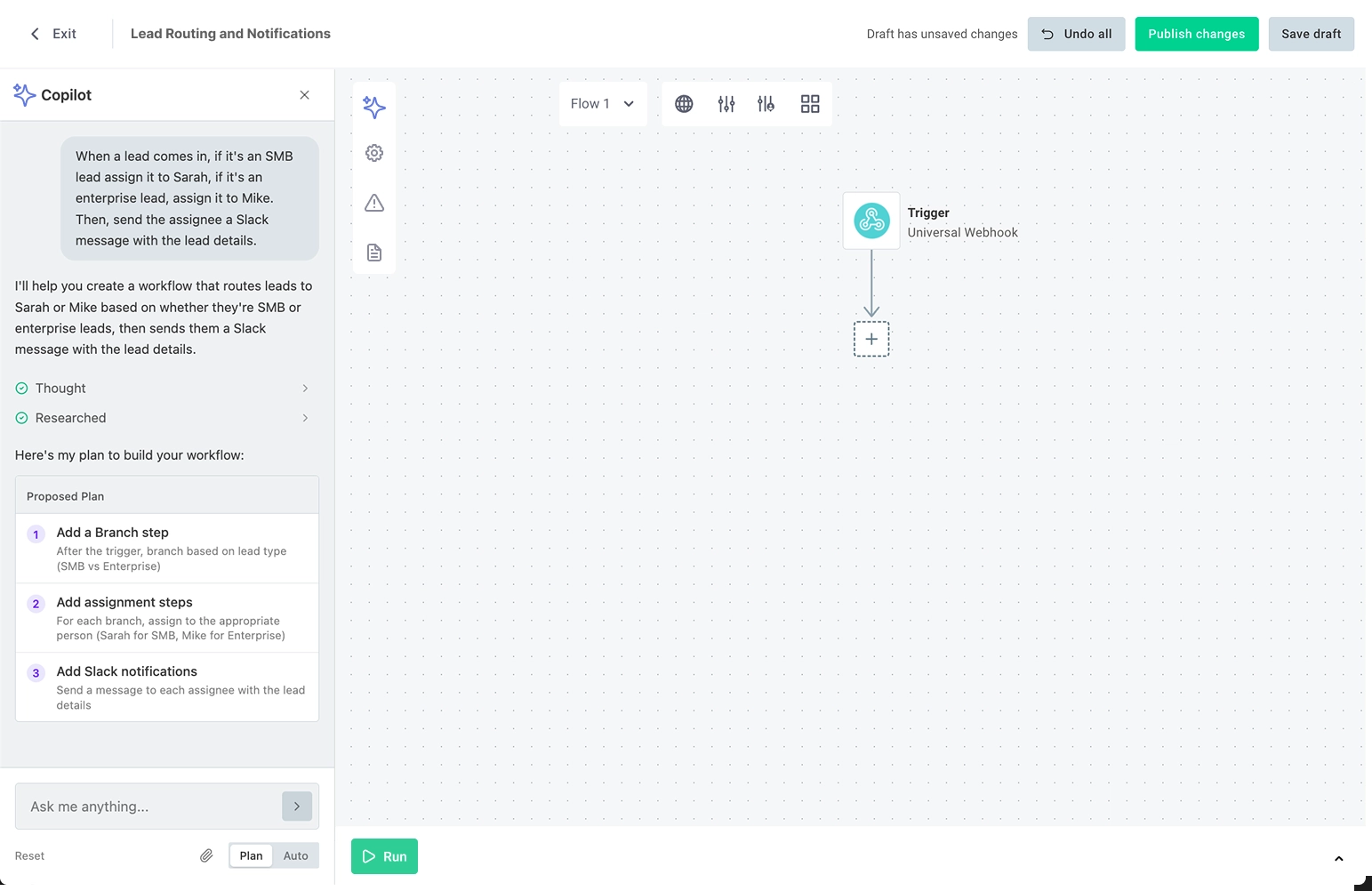
        <content type="html"><![CDATA[<p>The AI copilot for the embedded workflow builder is now generally available to all customers who have embedded workflow builder enabled.
Read more on our <a href="https://prismatic.io/blog/ai-copilot-for-embedded-workflow-builder-early-access/" target="_blank" rel="noopener noreferrer" class="">announcement blog post</a> and in <a class="" href="https://prismatic.io/docs/embed/workflow-builder/ai-copilot/">docs</a>.</p>
<p><span class="wrapper_oYSK"><style data-emotion="css 1wz7j1i">.css-1wz7j1i{background-color:#0000}@media print{.css-1wz7j1i{position:absolute!important}}</style><span style="display:inline-block;margin:0;max-width:700px"><img decoding="async" loading="lazy" alt="Screenshot of AI copilot in embedded workflow builder" src="https://prismatic.io/docs/assets/images/ai-copilot-2bcbb1335a5604d53a83b8014d4ec01d.png" width="1543" height="1002" class="img_CujE"></span></span></p>]]></content>
        <category label="AI" term="AI"/>
        <category label="Workflow Builder" term="Workflow Builder"/>
    </entry>
    <entry>
        <title type="html"><![CDATA[Workflow Contexts for Embedded Workflow Builder]]></title>
        <id>https://prismatic.io/docs/changelog/2026/04/16/workflow-contexts-for-embedded-workflow-builder/</id>
        <link href="https://prismatic.io/docs/changelog/2026/04/16/workflow-contexts-for-embedded-workflow-builder/"/>
        <updated>2026-04-16T00:00:00.000Z</updated>
        <summary type="html"><![CDATA[You can now define workflow contexts to give your customers a guided starting point when they create workflows in the embedded workflow builder.]]></summary>
        <content type="html"><![CDATA[<p>You can now define <strong>workflow contexts</strong> to give your customers a guided starting point when they create workflows in the embedded workflow builder.</p>
<p>A context pre-configures the trigger and its inputs and accepts runtime data from your application.
For example, a "Create automation" button on a ticket page can create a workflow that is already wired to your "Ticket updated" trigger and scoped to that ticket's project - no blank-canvas decisions required.</p>
<p>Use the new <code>prismatic.createWorkflow</code> SDK method to create a workflow from a context, and <code>prismatic.queryWorkflows</code> to list workflows by context or external ID.</p>
<p>Additionally, you can dictate which components and actions are available to your customers when building workflows from a context, giving you more control over the experience and ensuring customers only use components that are relevant to the workflow they're building.</p>
<p>See <a class="" href="https://prismatic.io/docs/embed/workflow-builder/workflow-contexts/">Workflow contexts</a> for setup instructions, SDK usage, and TypeScript typing support.</p>]]></content>
        <category label="Workflow Builder" term="Workflow Builder"/>
    </entry>
    <entry>
        <title type="html"><![CDATA[Prismatic Skills for Claude Code]]></title>
        <id>https://prismatic.io/docs/changelog/2026/04/15/prismatic-skills-for-claude-code/</id>
        <link href="https://prismatic.io/docs/changelog/2026/04/15/prismatic-skills-for-claude-code/"/>
        <updated>2026-04-15T00:00:00.000Z</updated>
        <summary type="html"><![CDATA[Prismatic Skills is an open-source Claude Code plugin that provides your AI coding assistant with the context and tools necessary to be an expert on Prismatic.]]></summary>
        <content type="html"><![CDATA[<p><a href="https://github.com/prismatic-io/prismatic-skills/" target="_blank" rel="noopener noreferrer" class="">Prismatic Skills</a> is an open-source Claude Code plugin that provides your AI coding assistant with the context and tools necessary to be an expert on Prismatic.</p>
<p>Key skills include a code-native integration builder, custom component builder, embed advisor for embedding the marketplace and workflow builder, migration analyzer for migrating integrations from other iPaaS platforms, and Orby - a platform expert for querying your Prismatic environment and troubleshooting.</p>
<p>Read more on our <a href="https://prismatic.io/blog/introducing-prismatic-skills-for-claude-code/" target="_blank" rel="noopener noreferrer" class="">announcement blog post</a> and in <a class="" href="https://prismatic.io/docs/custom-connectors/get-started/ai-assisted-development/">docs</a>.</p>]]></content>
        <category label="AI" term="AI"/>
        <category label="Dev Tools" term="Dev Tools"/>
    </entry>
    <entry>
        <title type="html"><![CDATA[New Components - April 2026]]></title>
        <id>https://prismatic.io/docs/changelog/2026/04/01/new-components-april-2026/</id>
        <link href="https://prismatic.io/docs/changelog/2026/04/01/new-components-april-2026/"/>
        <updated>2026-04-01T00:00:00.000Z</updated>
        <summary type="html"><![CDATA[We are pleased to announce the following components have been recently added to the Prismatic library:]]></summary>
        <content type="html"><![CDATA[<p>We are pleased to announce the following components have been recently added to the Prismatic library:</p>
<ul>
<li class=""><a class="" href="https://prismatic.io/docs/components/aws-redshift/">Redshift</a> - Amazon Redshift is a cloud data warehouse service. Use the component to manage clusters, execute queries, load data, and monitor warehouse performance.</li>
<li class=""><a class="" href="https://prismatic.io/docs/components/sap-ecc/">SAP ECC</a> - SAP ECC (ERP Central Component) is an enterprise resource planning platform for managing core business processes. Use the component to manage business objects, transactions, and data across modules like finance, logistics, and human resources.</li>
<li class=""><a class="" href="https://prismatic.io/docs/components/ssv/">System Surveyor</a> - System Surveyor is a visual documentation platform for physical security and IT systems. Use the component to manage surveys, sites, devices, and floor plans.</li>
</ul>]]></content>
        <category label="Connectors" term="Connectors"/>
    </entry>
    <entry>
        <title type="html"><![CDATA[New Components - March 2026]]></title>
        <id>https://prismatic.io/docs/changelog/2026/03/06/new-components-march-2026/</id>
        <link href="https://prismatic.io/docs/changelog/2026/03/06/new-components-march-2026/"/>
        <updated>2026-03-06T00:00:00.000Z</updated>
        <summary type="html"><![CDATA[We are pleased to announce the following components have been recently added to the Prismatic library:]]></summary>
        <content type="html"><![CDATA[<p>We are pleased to announce the following components have been recently added to the Prismatic library:</p>
<ul>
<li class=""><a class="" href="https://prismatic.io/docs/components/datadog/">Datadog</a> - Datadog is a monitoring and analytics platform for cloud-scale applications. Use the component to manage monitors, events, metrics, dashboards, and incidents.</li>
<li class=""><a class="" href="https://prismatic.io/docs/components/salesforce-marketing-cloud/">Salesforce Marketing Cloud</a> - Salesforce Marketing Cloud is a digital marketing platform for managing customer journeys across email, mobile, social, and advertising channels. Use the component to manage contacts, campaigns, data extensions, and automations.</li>
<li class=""><a class="" href="https://prismatic.io/docs/components/surveymonkey/">SurveyMonkey</a> - SurveyMonkey is a leading online survey platform that enables organizations to create surveys, collect responses, and analyze feedback at scale. Use the component to manage surveys, collectors, responses, contacts, and webhooks.</li>
<li class=""><a class="" href="https://prismatic.io/docs/components/ukg-pro/">UKG Pro</a> - UKG Pro is a human capital management (HCM) platform. Use the component to manage employees, organizational structures, payroll data, and talent onboarding processes.</li>
</ul>]]></content>
        <category label="Connectors" term="Connectors"/>
    </entry>
    <entry>
        <title type="html"><![CDATA[AI Copilot for Embedded Workflow Builder]]></title>
        <id>https://prismatic.io/docs/changelog/2026/03/03/ai-copilot-for-embedded-workflow-builder/</id>
        <link href="https://prismatic.io/docs/changelog/2026/03/03/ai-copilot-for-embedded-workflow-builder/"/>
        <updated>2026-03-03T00:00:00.000Z</updated>
        <summary type="html"><![CDATA[You can now enable an AI copilot in the embedded workflow builder to assist your customers as they build their own workflows.]]></summary>
        <content type="html"><![CDATA[<p>You can now enable an AI copilot in the embedded workflow builder to assist your customers as they build their own workflows.
The copilot can configure connections, triggers, actions, branches, loops and more based on natural language instructions from your customers.</p>
<p>See our announcement <a href="https://prismatic.io/blog/ai-copilot-for-embedded-workflow-builder-early-access/" target="_blank" rel="noopener noreferrer" class="">blog post</a>.</p>
<p>The copilot feature is in "Early Access" and will be generally available soon.
If you'd like early access to the copilot, please reach out to your Prismatic account manager.</p>]]></content>
        <category label="AI" term="AI"/>
        <category label="Workflow Builder" term="Workflow Builder"/>
    </entry>
</feed>